
Every few months the same thing happens. A season gets announced, forty shows arrive, you pick six, and by week four you are three episodes behind on two of them and completely lost on a third. Six months later you have a screen full of half-finished thumbnails and a vague sense of having wasted a quarter of your year. That is not a discipline problem. It is an information problem, and it has the same fix every time.
The fix is to stop treating a season as a list and start treating it as a shortlist with a budget. Right now that means the fall 2026 season, and the fall 2026 listing on AniList shows exactly the shape of the problem: new runs of Black Clover, The Apothecary Diaries and Aoashi, premieres including Firefly Wedding and Overgeared, and A Wild Last Boss Appeared! Season 2 already running from 26 September. There is more where that came from, and there always is.
Why a season feels like a dump
Nothing is wrong with the shows. The problem is volume versus attention. A typical cour puts somewhere around forty new series in front of you, and a weekly simulcast slot is a two-hour evening you cannot do twice. If you try to keep pace with even eight shows, you are asking for sixteen hours of television a week, which is more than most people spend on all their leisure put together.
What makes it worse is that the announcement is not the same as the schedule. Studios announce dates, then move them, then split a season into two halves, then delay a second cour by six months because the production slipped. A show you were saving for autumn may quietly become spring, then autumn again. Once or twice a year that is irritating. Every year, it trains you to not commit to anything in week one, which is exactly the opposite of what makes a season worth following live.
There is also a subtler cost. Following something weekly is a small repeated pleasure, and it is a completely different experience from a backlog you intend to get to. Half the reason a mid-season show works is that you are at episode five when the show makes its big move, and you saw the speculation threads before the answer. Binge-watching the same show a year later is watching a different thing. The queue is not a substitute for the season.
What a season actually contains
Once you know the four categories, the forty titles sort themselves. Continuing series are shows that started earlier and picked up new episodes, usually in a split structure, and they are the ones people forget are in the season. Franchise returns are second or later seasons of something you may have never watched, which is a trap because a returning series is not an entry point even when it is number three.
Adaptations are the third group, and here the source material tells you a lot in advance. A story that ran for five years in a magazine has room to breathe and will usually be paced deliberately. A story that ran for one volume may have had a lot added in the middle. Look at the studio rather than the publisher, too, because a studio doing a good job on something small is the single most reliable signal in a lineup. Ufotable’s first season of Demon Slayer was 26 episodes, animated to a standard that is still the reason the show runs at a fraction of the season’s speed, and that is a studio with the schedule to spare.
The fourth group is originals, which are the ones nobody is advertising in the press release and which are the easiest to miss and the easiest to regret skipping. The 2026 anime year page is a good cross-check when a lineup announcement leaves gaps, because it is compiled by series rather than by distributor. I want to be honest that the list is a rough shape, not a law. A season of forty can contain five originals and a season of twenty can contain fifteen, and the ratio tells you less about the shows than it does about how much a studio is producing.
Reading a synopsis without lying to yourself
The promotional text is the least reliable thing in this whole process, and it is the only thing most people read. A studio blurb is written to make you want the show, not to describe it, and the standard phrases all mean less than they appear to. A reimagining is usually the old story with one element changed, and the changed element is what the marketing is about. A story that has run for a decade is not automatically better paced, only longer, and a brand-new adaptation is not automatically faithful, only freshly risky.
Trailers are worse. Marketing is assembled from the best four seconds in the show and frequently from a section that is not representative of the other forty episodes, which is why so many people start something on the strength of a fight scene and abandon it during a dialogue stretch in episode four. If a trailer is the only information you have, treat it as information about the studio’s taste and not about the show’s content.
What actually predicts whether you will like something is genre, studio and one piece of premise, and you can usually establish all three without watching anything. A quiet workplace drama about a professional who does their job well is a different thirty hours of television from a quiet workplace drama about a professional who cannot stop breaking rules, and the blurb will happily describe both as a story about finding one’s place. So read the premise sentence, ignore the adjectives, and check the genre label against what you have actually been finishing lately rather than what you liked ten years ago.
Four questions that filter any lineup
Run every title on the announcement list through the same four questions and the list becomes short enough to act on.
Is it a continuation? If a show is in cour two of something with a story already in progress, you are making a commitment you cannot fairly assess from a synopsis. If you have not watched what came before, either start from cour one now or skip it. Season two of a show you missed is the worst possible starting point and it is where a lot of people get stuck.
How many episodes, and how committed is the source? Twelve or thirteen episodes is a clean, small commitment you can abandon at zero cost. A one-cour adaptation of a long manga is the ideal, and a two-cour split of a story that is still ongoing is the one to be careful with, because the second half arrives months later and the show has usually reserved its best material for it.
Did it get delayed before? A show that has already slipped once is the most likely to slip again, and a show that has slipped twice usually arrives in an unusual shape. Check whether the studio has announced a split, and if it has, decide now whether you are a cour one or a cour two person, because those are two different experiences of the same story.
And the one people skip: is this actually for you right now. The strongest show in a season is still a bad use of your time if you are tired, or if you have four shows already going, or if the genre is one you are not enjoying at the moment. There is no prize for finishing a season.
The episode budget nobody makes
Here is the arithmetic that finally sorted this out for me. Decide in advance how many episodes per week you will watch, and let the number set the list rather than the other way round. Most people land somewhere between six and ten, which sounds low until you add it up: eight weekly episodes is about two and a half hours a week, or roughly a hundred and thirty hours across a full cour. That is two months of evening television spent on five or six shows, which is a real commitment and a good one, but only if you chose it.
Then split the list into two tiers. Tier one is what you follow live, and you defend it, which means nothing else gets added until something drops out. Tier two is what you have heard is good and will take later from a completed season, where there is no risk of spoilers and no chance of a cliffhanger landing on a week you are already busy. Keeping tier two in your head is important because it means the shows you are not watching are not a source of guilt. You have a plan for them.
The most underrated move is scheduling one show’s episode so it lands on a day when you already watch something else. A twelve-episode show is a fixed twelve-week block. Put it next to a show you already follow weekly and the marginal cost of that evening drops to nearly zero, because you were not going to sit on the sofa anyway.
The continuous series problem
Continuing shows are where seasons get complicated, and One Piece is the extreme case that teaches the lesson. The anime passed 1,177 episodes in early September 2026, and the show’s schedule was restructured in 2026, with a winter break and a move to a two-course structure capped at about 26 episodes a year. Elbaph continues in the Elbaph Arc Part 2 run, with new episodes on Sundays and English dubs scheduled weekly from 20 October.
Strip the headline off that and the useful fact is this. A long-running show is no longer a weekly anime, it is an appointment. You are not tracking a season any more, you are tracking one arc. So stop asking whether you have caught up on One Piece, which is unanswerable, and ask whether you want this arc, which is a four-question question like any other. The Elbaph run is roughly a season of material about giants and a set of characters who mostly arrived recently, and on that basis it is very watchable even if you arrived last week.
The same logic applies to anything that never finished. Detective Conan has been running since 1996. Naruto was 220 episodes before the sequel. A short run of a long show is not a lesser version of the show, it is the only version most people will ever watch, and the arcs are self-contained enough that you can enter late without a briefing.
Catching up without ruining the season
You have eight episodes of something to watch and forty minutes a week. Do not try to catch up during the season, because that just means you watch the first eight episodes of the new show in a weekend and then the story never lands. The correct answer is to delay by a week and start it live.
Some shows are more damaging to skip than others. A mystery series is ruined by skipping and also by someone explaining it in your notifications. An action show with a tournament arc is ruined by skipping because the whole structure is anticipation. A slow dialogue show is genuinely fine to skip episodes of, and if you are in a mood for that on a week you are tired, it is the right place to make that trade. Know which type you are entering before you decide.
For anything with a deep or sprawling plot, look for an arc guide rather than a scene-by-scene summary. Arc guides tell you which episodes matter, which is the only information you need. Full episode recaps are for people who already watched it, and reading one before you start spoils the entire season without any of the work.
Launch week, the only week that sets the tone
Everything about how a season goes for you is decided in the first fortnight, and most people lose it by trying to sample everything. Watching episode one of eleven shows tells you almost nothing, because the first episode of a good show is deliberately incomplete and the first episode of a bad one is at its best. So instead of tasting, commit to your tier one list and let the rest go until they are finished seasons, when you can watch them properly without a deadline.
Then watch in the right order, which is chronological within each show, not reverse-released. Simulcast series get their episodes in order and there is no need to be clever about it. The only real exception is a show that dropped a whole season at once, where you start from cour one and stop thinking about the fact that another forty episodes are waiting.
Give the first week a specific job. Get the full lineup with studio, episode count and genre, throw out anything you already know you will not watch, and end up with a list short enough to feel slightly uncomfortable. That discomfort is the point. Every show on it should be one you could defend out loud to somebody who watches a lot of anime, because by week three you will be asked, and the honest answer is a better filter than any score.
One last piece of launch week advice. Do not build your whole evening around a premiere. Premieres land on weeknights, often two or three of them at once, and the week they land is the worst week to reorganise your life. If something premieres at eleven at night in your time zone, start it the next morning. You will not lose anything, and you will avoid starting a show you would have liked while exhausted.
What the airing mode shows you
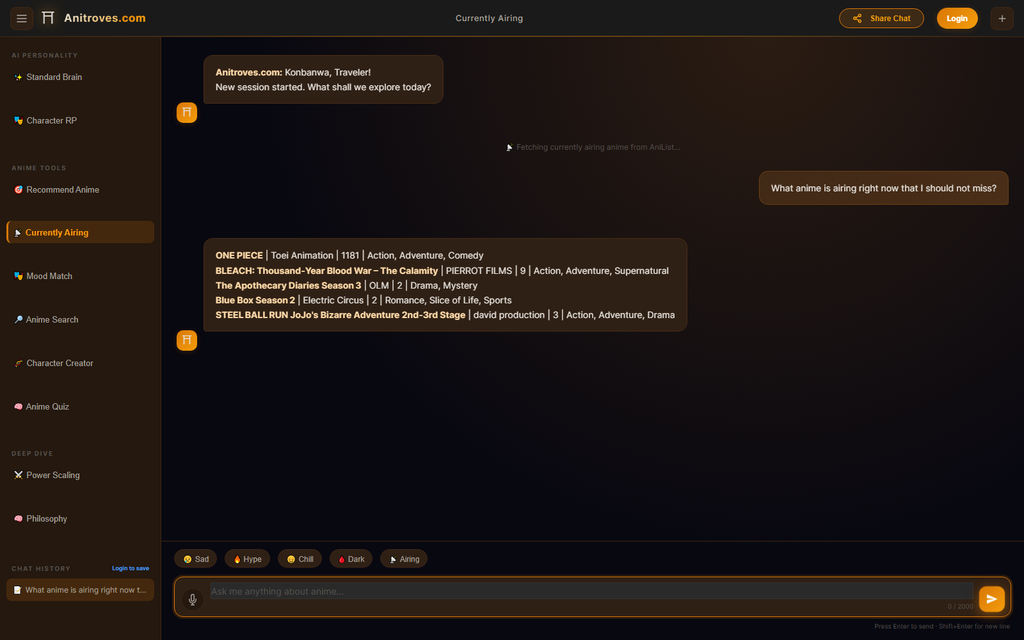
This is where Otaku AI is genuinely more useful than a scraped listicle, because of one design decision. Its currently airing mode does not answer what is good this season, which would be an opinion and would go stale in a fortnight. It answers what is airing this season, using live data, and it returns every title in the same four columns: title, studio, episodes so far, and genre.
That format is doing real work. Studio tells you the production ceiling and the schedule risk. Episodes so far tells you where the show is, which is the number people forget to ask and the one that decides whether you are starting at episode one or joining a running show in week four. Genre tells you how many of the twenty titles you have bookmarked are actually the same show with a different coat. Three columns, no adjectives, and you can scan a whole cour in under a minute.
Because the answers are pulled from live sources rather than trained-in memory, the list is correct in October and correct again in February, which is the whole problem seasonal lists have. Ask it for the season, ask it again in four weeks, and the episodes-so-far column will have moved on. It also runs in Japanese and English, so you can ask in either and get titles back in the form you actually search for.
When a season falls apart anyway
It will. Four or five weeks in, one show will have got bad, one will have got slow, and one will have a schedule you cannot live with. The only question is whether the remaining shows survive the collapse, and they usually do if you made the cut early enough.
Dropping a show you are three episodes into costs nothing, which is why the four-week mark is the right moment to decide rather than pushing to episode eight out of sunk-cost feelings. For shows you were enjoying and want to keep, the fix is usually to stop treating them as urgent. A cour that splits into two halves has a natural gap in the middle, and that gap is where a show you fell behind on gets caught up without anything else having to stop.
And for anything you do not want to see the end of, write down where you stopped. The real reason people abandon shows permanently is that they cannot remember whether they meant to or just forgot. Note the episode number, note whether you want to come back, and the backlog stops being a guilt list and becomes a list. AniList tracks per-show progress and status for exactly this, and its API documentation shows the fields, if you want to keep your own list somewhere you control.
If you are still choosing, the should you watch it decision guide is the one to read before you press play, and finding anime from one remembered scene is the fastest route when someone mentions a show mid-conversation. The personal anime guide to Otaku AI has the other modes in context, and picking something by mood is the right call on a week when the season list is too much decision.
Keep reading