There is a specific moment where most original character projects quietly die, and it is almost never the drawing. It is the first hour. You have a name, a hair colour, maybe a weapon, and you are staring at an empty box labelled Backstory with nothing to put in it. The character looks like a character sheet. They do not feel like somebody who would have to make decisions in front of a camera for a hundred and fifty episodes.
That failure has a cause, and the cause is fixable. Anime characters that hold up are built from the inside out. They want something specific, they are bad at getting it, and the wanting costs them something real. Appearance and power set come last, because they only mean anything once the rest is standing up. That is the order below, and it is the same order Otaku AI works in when you switch on its character creator mode, which fills in a name, age, appearance, personality, backstory, powers and the series the character would slot into.
The problem with starting with a name
Almost everyone starts at the wrong end. Name, hair, outfit, weapon, done. It feels like progress because the screen fills up, and it is the reason so many handmade characters read as an art asset rather than a person. Take a name like Rei Ayanami and put it on a stranger. The name is doing half the characterisation before a single frame moves. Yoshiyuki Sadamoto, the character designer for Neon Genesis Evangelion, has described the cast as being drawn from Shinji’s point of view, which means the designs were never meant to be judged as cool shapes on their own. They were meant to tell you what the protagonist sees when he looks at other people. VIZ’s series page puts him plainly as the character designer, and his interviews from the period when the Evangelion manga finished are worth reading on that point.
The useful mental flip is to stop treating the character as a design and start treating them as a problem. Who is this person trying to solve, what have they already failed at, and what will they do next? Once you can answer that in three sentences, the hair colour stops being arbitrary and starts being a choice you can defend. If you cannot answer it, no amount of visual detail fixes it, because the viewer is not missing context. The context was never written.
Want before ability
Every character worth building has a want, and most weak ones have only a want. A want is what they will say out loud. Eren Yeager wants freedom, and everything he does across four seasons is a loud, increasingly terrible attempt to buy it. Thorfinn wants revenge on Askeladd, and the twenty-four episode second season of Vinland Saga is largely about what happens when that want finally arrives and turns out to be hollow. Levi Ackerman wants to be left alone, which is why every time somebody makes him care, the scene gets colder rather than warmer.
Then there is the need, which is the thing they cannot say. The most efficient way to build a character is to make the want and the need point in opposite directions, and to give them both a specific, arguable definition. Freedom can mean nobody owns me or it can mean nobody I love gets taken, and those two readings produce two completely different protagonists. Write your want and your need as two sentences, each under fifteen words, on two different lines. If they read the same, you have a character with a personality but not a story.
Personality is what a decision costs
Traits are cheap. Kind, stoic, loud, anxious, protective. Any of those can be printed on a jacket. Personality only becomes visible when it makes somebody do something they would rather not do, usually against a clock, usually in front of people whose opinion matters.
Here is the test I use. Take your character and put them in three situations. A friend is insulted in front of them. A stranger needs help and helping costs them something. They are losing, badly, and someone they respect is watching. Write the reaction each time, then read them in order. Bakugo answers all three with escalation and volume. Itachi answers all three with silence and a decision he will not explain. Nobara answers all three bluntly, including to people she likes. If your three answers are the same shape, you have written a trait. If they are the same emotion but different tactics, you have written a personality.
One more thing that separates a personality from a mood: consistency under a rule. Levi’s rule is that the strongest person in the room decides what happens, and he does not negotiate with anyone about it, including people he respects. Rules make characters predictable, which is what makes them satisfying to watch across dozens of episodes.
Abilities need a price, a limit and a mistake
Powers are the easiest part to add and the easiest part to ruin. An ability with no cost is a solved problem, and a solved problem ends a fight before it starts. Gojo Satoru’s Limitless and Six Eyes are the cleanest example of a power that costs him: with the Six Eyes running constantly he burns through the world around him, and the toll shows in his own body. Give an ability three things and it becomes drama instead of a stat block.
First, a price. Time, memory, sight, lifespan, another person’s safety, something. Second, a hard limit, and a limit that is a rule rather than a number, because rules invite tactics. Third, a moment where they used it badly. Not a near miss, an actual one, with a person on the receiving end, and the character remembering it. That third piece does more characterisation than a page of backstory, because it tells you what the character thinks of themselves.
There is also a structural trick worth stealing. The best abilities in action anime are solutions to problems the character keeps causing. A power that only helps is decorative. A power that is also, faintly, the reason everything is on fire gives you a protagonist, because now their gift and their damage are the same object and the show gets to ask whether the answer is to grow up or to get stronger.
Write the backstory as three scenes
Prose biographies are where original characters go to sleep. Nobody in an anime delivers a life summary. A backstory earns its place only when it comes back later as a behaviour, a reflex, or a line somebody says twice. So write three scenes and nothing else.
The last good day, where everything still worked and they were not the protagonist of their own life yet. The day it ended, which should be the specific moment rather than the general disaster. And the day they told themselves the story they now believe, which is the version they sell to other people and the version that is quietly wrong. That third scene is where most of the good material lives, because it gives you a lie to expose and a character who has an interest in never being corrected.
Scale matters here too. Attack on Titan ran in the manga from 2009 to 2021 and passed 140 million copies in circulation by late 2023, and the anime only reached 94 episodes because seasons one to three were made by WIT Studio and the final run was picked up by MAPPA, finishing in autumn 2023. Twenty years of source material, compressed. A backstory does not need to cover a childhood. It needs to cover a decision, and the character has to still be making versions of that decision in the present.
Appearance as information, not decoration
A good anime design lets you guess the character from a silhouette. Three rules, in order. Give them a shape you can read at a distance, because most of what you remember from a show is a thumbnail, a key visual or a trading card. Give them exactly one unusual feature, since a second one stops being a signature and starts being a costume problem. Then make the character do one thing to that feature, repeatedly, in a way that reports their mood.
Scar tissue is the most abused one in the medium, and it should be used carefully because scars are not free. Levi has two of them from outside his story, and they arrive before the audience learns what they cost. Gin’s deformation in Monster is the same idea pushed further, where the body is a record of a plan. Obito’s mask is the loudest version, and it works because it is a decision he makes rather than a wound he receives.
Contrast is the other half. Give a loud character something small and controlled to handle, and a quiet character one thing they cannot stop fidgeting with. Clothing does the same work: what someone wears when they are safe, and what they put on when they are not, tells you where the character draws the line between performing and being real.
Age decides the shape of the arc
Pick the age before you pick anything else, because it sets the stakes. A fourteen-year-old protagonist wants to be understood, proven, accepted or left alone, and every one of those wants is a little embarrassing, which is exactly why it is watchable. A protagonist in their thirties has already made several irreversible choices and now has to live in a world where other people pay for them. Same character design, completely different story.
Look at how the same trait changes across ages. Eren at fifteen is a boy who wants to see the ocean. Eren at nineteen is a man who has turned an entire nation’s history into a weapon, and the design barely changed while the moral weight multiplied. Edward Elric in Fullmetal Alchemist is eleven and makes decisions like a child, and the show knows it, so the plot treats his judgement as unreliable in a way it never does for an adult lead.
Non-human lifespans are the fastest way to distort a character, and the best recent example is Frieren. The first season of Frieren ran to 28 episodes and the second, which finished in March 2026, was a deliberate ten, and that short run exists because the manga is a slow accumulation. An elf who has lived for centuries is a character for whom most other people are a brief, forgettable event, so the whole story is about the specific mechanics of being unable to grieve on schedule. If your character has an unusual lifespan, the show is now about time, and you should decide early whether the character is broken by that or has simply arranged their life around it.
Naming a character people remember
Naming is genuinely the hardest part and the part most people rush, because the name is what they have when they open the app. Anime names rarely land as random. There is usually a meaning underneath, and it usually points at where the character is going rather than where they are. Naruto Uzumaki carries the whirlpool his family is named for and the fox name nobody in the village will say, so the name holds both the thing he is named after and the thing he is rejected for. Kakashi means scarecrow, which is a joke the village tells about a dead man, and the character spends the series not correcting them.
So build the name backwards. Decide what the character is meant to become, decide what the family gave them, and let those two things disagree. A name where the family expected one thing and the character became another tends to age well, because the rest of the story is playing out the gap. Watch the translation pass on any dub and you will see how much of this gets flattened, which is a decent argument for building the concept in the language you are actually going to present it in.
The test: which anime would they fit into
Every character needs a home genre, and the question is not which show is biggest. It is which production would hire this person. So answer four things. What is the genre and tone, in one adjective plus one concrete noun, so dark low fantasy and workplace comedy, not epic. What is the role, because roles are what a cast is actually short of: protagonist, rival, mentor, the antagonist’s decent colleague, the wildcard who survives arcs the main cast does not. What does the character want from that other role, and what is the specific friction between the two. And what is the recurring setting, because a character who could be dropped into any show has not been built yet.
If you cannot name the show, name the neighbours. Say the character would work next to Levi, or next to Koshiro from Blue Lock, or next to Okko in Aria, and you have said more than a genre tag. Real shows are made of characters who fit against each other specifically, which is why the same concept lands differently next to a different cast. A quiet, observant support character is unremarkable next to a loud rival and genuinely tense next to a silent one, and the character you design needs to know which of those you are building toward.
Building the sheet in Otaku AI
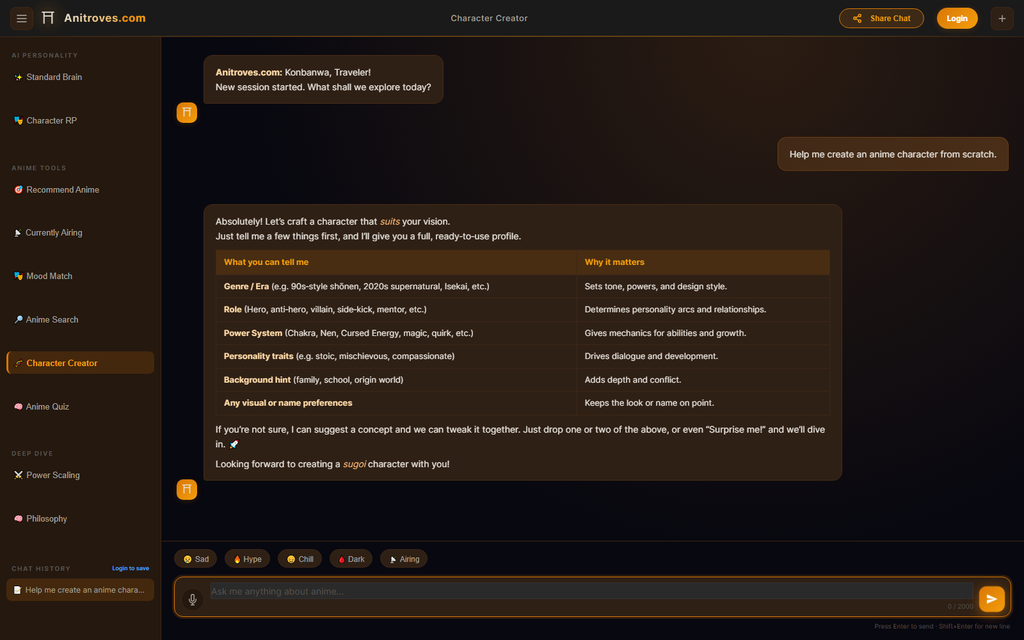
Now the tooling. Otaku AI’s character creator mode produces a full sheet in one pass: name, age, appearance, personality, backstory, powers or abilities, and the anime the character would fit in. That order is the whole lesson of this article, because the fields are arranged so you have to supply a want before you can get a design back. Give it one line of real intent, something like a former guild accountant who can price any object, and it fills the seven fields with material you can argue with rather than material you have to accept.
Iteration is where it earns its keep. Treat the first sheet as a draft you marked up, and change one field at a time. Swap the power, then ask for a story that would break because of it. Change the age up five years and see if the backstory still makes sense. Ask it to explain why the character would be in the room during the first scene of the show they fit, since that single question kills more weak characters than any other test. Because the whole conversation is kept in memory, you can push the same character across many revisions without restating the premise, and the more specific details you feed it the less generic the results get.
If you want the full tour of the modes rather than just this one, the plain-language guide to every Otaku AI mode is the place to start, and the character match guide is a good next step once your own character exists, because the fastest way to test whether your personality writing is specific is to see which existing characters it ends up near.
If you want to pressure-test what you have built, the anime character quiz article covers how trivia gets graded, and the power scaling guide goes deeper on ability cost, limits and feat evidence. The personal anime guide to Otaku AI pulls all of these modes together in one place.
Keep reading
More like this
- UncategorizedAnime Character Quiz Ideas: How Well Do You Really Know Your Favorite Characters?Read article
- UncategorizedWho Would Win? How to Compare Anime Characters Without Just Picking the StrongestRead article
- UncategorizedHow to Find Currently Airing Anime Without Missing New EpisodesRead article