Anime trivia has a reputation problem that it mostly deserves. Someone hosts a quiz, the first question is a name shouting scramble, the third is a trick with two defensible answers, and by question five the fastest player is winning and the rest of the table has gone quiet. That is a bad quiz, and it is usually bad for boring structural reasons rather than because the material is thin. The fix is not harder trivia. It is better shapes, and there are about seven that work well enough to reuse indefinitely.
What follows is organised by format rather than by series, because series-based question lists are useless to anyone who has not watched the thing you picked. Pick a shape, feed it characters the group has actually seen, and it will keep working for years. The same formats carry a solo session just as well as a table of six, which matters because most people running anime trivia are doing it alone on a Sunday afternoon.
Recognition rounds are the warm-up
Start with recognition. It is fast, binary, and nobody resents it, which is exactly what a first round needs to do. The purpose of an opening round is to get everyone talking and to make the format feel safe, and a question everyone gets right is a better tool for that than a question that separates the table immediately.
There is more variety available here than most quiz nights use. Who says this line, read in character rather than described. Which character was carrying this weapon. Who is the only person in the scene not in a uniform. Which one is lying, given a clip of a villain. A describe-the-design round works well too, since anime characters are distinctive enough that “tall, scar over the left eye, and cannot stop eating” narrows the field faster than a fan will admit.
Voice actors are the version that gets skipped and they should not be, because almost nobody has studied them and the answers are so often genuinely surprising. A round built on who voices a character opens a door into a part of a fandom that most people enjoy and almost nobody explores. The one warning is to keep the difficulty honest: an obscure seiyuu name is a memory test rather than an anime test, and it produces the same dead table as a trick question.
Quote rounds that are not all famous
Every bad anime quiz uses the same six lines. The famous declaration, the mentor’s deathbed line, the villain’s catchphrase. They are easy and they are pointless, because a player who has never seen the show can still guess them from having been on the internet.
Better quote rounds pull from arcs rather than memes. Ask for a line delivered in the middle of a fight where the character is losing, when nobody clips it. Ask for a line said by the antagonist in the scene right before they abandon their plan. Ask which character says a given line, when the line is one the other fighter says in a different scene, because the near-miss is what makes it interesting. Villains are the richest source here. They talk constantly, they are often more articulate than the heroes, and the average viewer has spent more time with them than they think.
Accuracy matters more here than in any other format, and this is where most homemade quizzes quietly fail. Translations vary, and a line exists in three different English wordings depending on the stream, so a question built on exact wording can be marked wrong for a correct answer. Check your lines against the version the group is likely to have watched, and phrase questions about meaning rather than phrasing. A player should be able to answer in their own words and be right, otherwise the round is testing a translator.
Timeline questions, where order decides the answer
Sequencing is the best format in the whole list and almost nobody uses it, because it requires no obscure knowledge at all. It requires attention, which fans have in surplus, and it is very hard to fake your way through.
The basic shape is which came first, which is more forgiving because a near miss is still an attempt. The sharper version is four events in order, or which of these happened last, which is where it stops being forgiving. Long runs are ideal material, because the material is genuinely available to anyone who paid attention and genuinely unavailable to someone who binged a series in a weekend. Naruto‘s arcs give you a clean spine. Bleach’s are longer and messier, which makes them better. Attack on Titan rewards sequencing more than almost anything else, because the show deliberately distributes its revelations across a long run.
Reversal is the other half of this format. Ask which event a character was already present for, or which revelation a character missed. Sequencing questions that begin inverts the usual puzzle shape and quietly punish the person who has only skimmed summaries, which is a fairer way to catch that than a direct knowledge question.
Scaling questions for people who argue about power
For a group that already argues about power, a light round of comparative questions is the highest-energy format available and the most dangerous. The trick is to keep every question answerable from the show without requiring anyone to have read a wiki page.
Frame them as events rather than verdicts. Which of these characters successfully landed a hit, and which of them fought on the defensive for most of an arc. Which one fought at full strength for the longest stretch of a single arc. Which character’s most impressive moment was performed while they were injured. These are all answerable by someone who watched, they produce real arguments, and they never require anyone to concede that a character is stronger than another, which is the statement that ends the evening.
If a player pushes toward an actual verdict, that is a good moment to hand the argument to something that can carry it. The matchup guide covers how to run a fight properly, and the mechanics behind the numbers are set out in the piece on how power scaling works. Settle the format, run the quiz, and let the real argument happen afterwards on a surface built to hold it.
Relationship maps, where the whole family shows up
Relationship questions are the format most suited to ensemble casts, and the reason they work is that the answer is a connection rather than a name. Who raised whom, who is a former student of whom, who betrayed an alliance, which two characters fought as allies before fighting as enemies. Nobody memorises a relationship diagram, so these reward the people who were paying attention to the story rather than the people who had the wiki open.
Long-running shows are made of this material. Bleach builds entire arcs out of former relationships, Naruto is structured around two rival families, and Hunter x Hunter pairs a set of characters whose powers only make sense relative to each other. That last one is worth a round of its own, where the question is about how a technique works rather than who used it, and a player who watched carefully can explain the answer even when they cannot name it.
The best version of this format asks the question from one side only. Tell them somebody betrayed a captain, and ask who was standing on the other side of it. A relationship question phrased with both ends named is trivia. Phrased with one end and a behaviour, it is comprehension, and the difference shows up immediately in the quality of the conversation at the table.
Manga-only questions for the readers who cheat
Nearly every anime fandom contains a minority who have read the source material, and those people will wreck a general quiz if you let them, because the answer is already in their head before you finish asking. There are three reasonable responses and the first two are much better than the third.
Put the source material in a spoiler-gated round at the end. Say clearly that the next block is for people who have read past the anime, and let the rest of the table sit out or guess blind. It turns an unfair advantage into a feature, and it rewards the reader who has been waiting forty minutes for their turn. Second, and this costs nothing, check whether the anime adaptation changed the thing you want to ask about. Adaptations reorder, soften and cut constantly, and a manga question with a clean anime answer is a free point for everyone.
Running manga-only questions as an unannounced round is the option to avoid, because the only way a table-guest avoids it is by lying about what they have read, and you have then taught them that lying is the efficient strategy for the rest of the night. If the group does not know who the readers are, ask, or let people claim it themselves. A quiz works on trust, and this is the one place people tend to quietly break it.
The questions that never work
Some formats are reliably bad and it is worth naming them so a group does not rediscover them every month. Questions with no single defensible answer are the first. Who would win, who is the strongest, and which character is the most complex are all arguments wearing a question mark, and they end the quiz rather than advancing it.
Questions answerable by looking things up are the second. Episode counts, release dates, studio trivia, the name of a staff member. Nobody objects to this once, and then the quiz becomes a series of phone lookups with a scoring system. The exception is a deliberate research round at the very end, where everyone is allowed a phone, because at that point it is a different game and an enjoyable one.
Questions with hidden gotchas are the third, and they are the reason so many anime quizzes have a bad reputation. A question whose answer is the character who appears for four seconds in the background, asked in a round the same difficulty as a plot question, is not difficult. It is unfair, and unfair feels identical to hard from the losing side. The fourth category is spoiler questions asked to someone who is three episodes into a show, which is not a quiz problem so much as a friendship problem.
There is a fifth, quieter one. A quiz where the host visibly wants a particular character to win, or visibly wants a certain player to be impressed, stops being a quiz. That is the reason to hand the scoring to something that has no preferences, which is the entire argument for the next few sections.
Running a quiz alone so it stays fun
Solo trivia has one advantage and one trap. The advantage is that nobody is watching, so the only person you can embarrass is yourself. The trap is that a quiz you run alone with a visible score becomes a test, and tests are not fun, which is an uncomfortable thing to discover about a hobby you spent nine hundred hours on.
The fix is to change what the score is for. Instead of a number, keep a list of the questions you got wrong, because that list is genuinely useful. Every miss is either a gap in attention or a scene you skimmed, and both are a rewatch target. Most people running anime trivia alone already know the trivia and want the same thing, which is an excuse to go back to something they love with a reason attached. If you are the sort of viewer who has finished four hundred episodes and could not tell you what happened in ninety of them, that list is the most useful artefact the exercise produces.
Keep a second list of questions that turned out to be ambiguous. You will find them, and they are worth keeping because they tell you what your own memory of the show has quietly filled in. A great many things fans remember confidently are wrong in small ways that only surface when you try to quiz them, and discovering that your favourite scene is remembered slightly wrong is a small shock worth having once.
Running one for a group without ruining it
Hosting for other people is where the well-meant quiz dies, and it dies on logistics rather than content. Nobody in the group has watched the same things, so the round has to be built from the intersection, and the intersection is smaller than the host assumes in the moment and much smaller than a first-time host planned in advance.
Ask what everyone has seen before writing a single question, and then accept a small quiz. A short round nobody finishes early beats a long one that drags. Do not quiz the finale of a series someone is halfway through. Do not build the whole night around the show the host loves most, because the host is the only person who came prepared to answer well, and the night will feel like a performance rather than a game. Mix difficulty and let the easy questions sit next to the hard ones, since a run of hard questions is what produces the silent table, and a run of easy ones is what produces the boring table, and the alternation is what keeps both engaged.
Two rules fix most of it. Miss something on purpose early, because a host who never misses is a host nobody wants to play against. And never score on how much someone knows, only on what they answered, which sounds obvious and is the thing that gets broken when a group is having a good time and the host is enjoying being right.
Letting Otaku AI handle the quiz
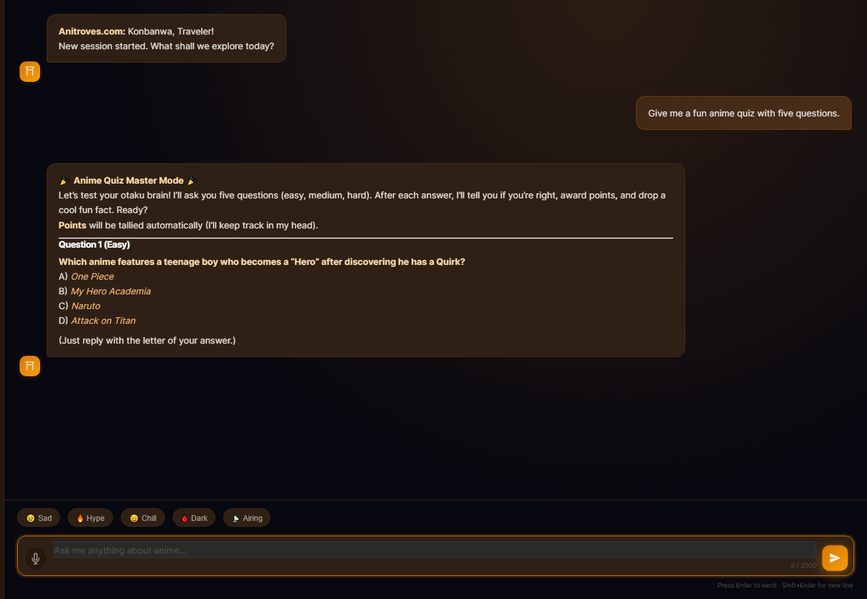
Most of the failure modes above come from the host being a person with favourites, and that problem disappears if the host is not a person. Otaku AI runs the Anime Quiz Master as interactive trivia, one question at a time, keeping the score internally and mixing easy, medium and hard questions across several eras. It is free and it runs in a browser, so there is no setup between deciding to play and the first question.
That structure suits the formats above rather than replacing them. One question at a time means a wrong answer costs you one question instead of the rest of the round, which removes the punishing part of a quiz night. Mixed difficulty across eras is roughly the shape of a good warm-up, and the internal score means the bookkeeping is handled without anyone keeping count out loud and getting accused of favouritism.
For a themed night, the general chat mode is the place to build the round first. Ask for questions restricted to a pair of series everyone present has finished, or for questions that avoid anything from a show somebody is mid-way through, and check the list before you start rather than discovering the problem in round three. The session carries the conversation forward and brings back stored facts and preferences on later requests, so a quiz night can span several sittings without losing which series the group was doing. If you are playing with a controller in one hand, the voice input means you can answer without typing. The interface is bilingual too, which is a small asset when a question depends on a line of dialogue.
If you want to know what else the thing does before you commit a Saturday to it, how Otaku AI works across every mode is the honest read, including the parts that are not trivia. And if the group wants something gentler than a test, working out which anime character you are most like turns the same material into a conversation instead of a scoreboard.
Once the questions run out, a scoring round is the natural follow-up, because the characters you keep getting wrong are the ones worth a closer look. The personal anime guide covers what to do with a gap in your knowledge, and if the night has turned into an argument about who would actually win a fight, the anime character creator is a better use of the argument than continuing it.
Keep reading