Ask four people who would win in a fight between two anime characters and you will get five answers, and at least one of them will be delivered with total confidence by someone who has never watched the shows. The reason is not that anyone is stupid. It is that “who would win” sounds like a simple question about two numbers, and it is actually a question about a fight, which has a setting, a sequence, a win condition and about forty variables that nobody mentioned. Get those four things straight and most matchups stop being arguments.
What follows is a way to run one properly, from naming the versions through to the moment somebody declares a winner. It leans on the same evidence work as how power scaling actually works, because you cannot forecast a fight you have not measured, but it goes somewhere different. Scaling asks what a character is capable of. A matchup asks what two characters will do to each other under stated conditions, and the gap between those two questions is where most bad analysis lives.
Why “who would win” is harder than it sounds
Rankings and fights are different objects. A ranking sorts characters against each other on one axis and stops there. A fight is a story with a beginning, a middle and an outcome, and the outcome is decided by order. Swap the order of two events in a duel and you can change the winner without changing a single statistic, which is why almost every matchup thread eventually collapses into people ranking characters rather than describing fights.
Jujutsu Kaisen makes the point better than an abstract example can. Gojo Satoru versus Ryomen Sukuna is genuinely conditional, and the condition is not about raw output. Gojo wins while his technique keeps working, and the Shibuya fight is precisely about the moment it stops working for him. Nothing about that outcome is settled by asking who hits harder. It is settled by asking how long a specific condition holds and what happens in the second it lapses.
There is a second trap, which is answering a different question than the one asked. Somebody asks who would win, and the response is a tier list. That is not a wrong answer, it is a different answer, and it usually gets marked down by everyone except the person giving it. If the question is about the fight, the fight is what you have to describe: who moves first, what the first exchange costs, and what each fighter is trying to accomplish in the minute before the fight stops being about skill.
Pick the version before you pick the fighter
A large share of confidently wrong matchups are not analysis errors. They are version errors, and they are trivially avoidable once you know to look for them. Fighters change more than readers expect across a long run. Luffy at the end of the Fish-Man Island arc is not the character who walks into Wano. A Gojo who has not yet learned to use his ability properly is a different fighter from one who has. A Levi with the ODM gear and no spare blades is a different problem from a Levi with a full set of replacements.
Then there are the versions that are not in the anime at all. Films contain fights that contradict the series they came from. Manga chapters get adapted with material cut, reordered or softened. A statement that appears only in a chapter book or a light novel is still usable evidence, but it has to be labelled as coming from outside the adaptation, because a large fraction of online arguments are two people who read different books.
The fix is dull and effective. Write down the exact chapter, episode or arc for both fighters before you look at a single stat, and note any place where the adaptation differs from the source. If you need to confirm which episode a scene sits in, the AniList API documentation maps series, episodes and airing data, and AniList itself will tell you the episode count you need to reason about a run at all. It takes two minutes and removes the single most common reason a matchup collapses.
Decide what winning actually means
“Winning” is a blank cheque, and each fighter can cash it in a different currency. Options include knocking the opponent unconscious, killing them, incapacitating them, outlasting them, protecting a third party, forcing a retreat, or simply surviving until someone else arrives. These produce different winners in the same matchup, sometimes from the same pair of characters, and the choice is yours rather than the story’s.
Stakes multiply the problem. A duel between two characters in an empty field is a completely different question from the same two characters in a city with people behind one of them, because the defender now has to choose between winning and protecting. Fighters defined by restraint stop looking restrained and start looking like they are making bad decisions. Fighters defined by recklessness get to be reckless. The arena is not a footnote to the matchup, it is a participant.
Baki is a good example of a series where the obvious win conditions are all wrong. Nobody wins a Baki fight by being tougher, so a matchup framed around durability produces a strange result with a technically correct explanation. Write the win condition as one sentence before you start. If you cannot finish that sentence, the matchup is not ready, and the numbers you collect in the meantime will not make it ready.
Speed decides who sets the tempo
Speed is the stat that decides what kind of fight you are having, because it decides who gets to choose what the fight looks like. A fighter who can act and react faster than the other can impose an exchange rate, and everything the slower fighter does has to happen inside gaps that are too small for them. That is a defensive advantage independent of how much damage either of them can output.
Keep three measurements apart here. Reaction speed is whether they can respond to an attack already in flight. Combat speed is whether they can initiate and land at that rate. Travel speed is mostly irrelevant to a duel and hugely relevant to a chase. A character who wins on reaction alone has not demonstrated the ability to dictate the fight, and a character who wins on travel speed has usually lost a conversation they should not have been in.
The underrated category is refusal. Plenty of strong fighters lose by fighting on the other character’s terms, and a good matchup asks what happens if the stronger party simply declines. Staying out of range, refusing the first exchange, using the environment to break line of sight and waiting for an opening is a legitimate strategy, not cowardice, and it beats a large number of otherwise superior fighters. Fighters built around burst damage lose badly to anyone who makes them miss, and fighters built around attrition lose badly to anyone who refuses to commit.
Durability decides how long you get
Attack potency tells you how much damage a fighter is carrying. Durability tells you how long the other one survives it, and the second number is what decides whether the first number matters. This is the point where matchups most often surprise people, because a matchup decided by a mismatch between the two is the most instructive kind there is: the fighter who outclasses their opponent in every offensive category can still lose because nothing they are throwing does anything to the person receiving it.
It runs the other way too. A fighter with modest durability and a fight-ending ability can win in one exchange, and their ability to stay upright for more than a minute after losing that exchange may be irrelevant. Matchups get this exactly backwards with hax-heavy characters, treating an inability to be hurt as a general defensive strength when it is specific to one type of attack. If the opponent’s entire kit is fire, a character who cannot be burned is not a tanky character, they are a solved problem, and the fight is over before the second minute.
Before you settle a matchup on durability, check whether the two are even measuring the same thing. Blunt force, piercing and slashing are different resistances, and an ability that attacks the body as information rather than as an object will not register on any of them. Getting the categories right is most of the work, and it is covered in more detail on the scaling guide.
Hax only counts if it lands
Abilities that bypass raw statistics decide more matchups than raw statistics do, and they are the easiest thing to get wrong in both directions. The overrating error gives a character a guaranteed win because the ability is devastating in the abstract. The underrating error ignores it entirely because the character is physically weaker. Both errors come from skipping the same question, which is what it takes for the ability to actually happen.
Every technique has a setup cost, and the setup cost is the real content of the fight. A seal that needs physical contact is useless against someone who never lets you touch them. A spatial technique that needs an enclosed space is unavailable in open terrain. A healing or regeneration effect buys time rather than winning exchanges, and against an opponent with overwhelming damage output it simply shortens the fight. An ability that only activates after the target has already been weakened is not an opening move, it is a finisher, and treating it as a threat in the first thirty seconds inverts the fight.
So walk the sequence forward step by step and ask what each fighter is doing while the other is setting up. A matchup where one fighter’s entire plan requires uninterrupted time and the other can deny time is not a close matchup, it is a solved one. Jujutsu Kaisen is worth reading closely here precisely because its domains are literal arena changes, and establishing one takes real time that a faster opponent may simply refuse to give.
The first move is often the whole fight
Most published matchups skip the opening entirely and argue about the endgame, which is like analysing a chess game from the final position. The first exchange sets the terms, and it costs far more than the two minutes it takes. A fighter who opens badly gives up the initiative, and initiative in a fight is the ability to choose which exchanges happen at all.
Aggressive characters and patient characters are the cleanest split. Against an aggressive opponent, the strongest defence is often to be somewhere else. Against a patient opponent who waits for an opening, the strongest offence is to refuse to provide one, because a patient fighter with nothing to react to has to improvise, and improvisation is the one thing controlled characters are worst at. The two styles also cover for each other’s weaknesses, which is why the most interesting matchups in any genre are the ones where neither character’s usual approach works.
Feints make this concrete. A fighter who has shown a reliable pattern can be played by someone who knows the pattern exists, and characters defined by a signature technique are the most exploitable in any series. Ask what the opponent knows going into the fight and what they are prepared for. A matchup that only accounts for what a character can do, and never for what they have already shown, is a matchup decided by the author of the story in advance.
The arena changes the answer
After the fighters, the setting, then the modifiers. List them explicitly rather than assuming a neutral one, because there is no such thing. Terrain, gravity, weather, available weapons, distance, cover, time of day, whether the fight is public, whether allies are nearby and how much preparation each side got all change the result, and several of them change it more than any statistic on the sheet.
Attack on Titan is a clean demonstration. Levi’s kit is designed for enclosed urban fighting, tight blade work and repositioning through a three-dimensional structure, and the same character in open ground with no gear is a different fighter rather than a weaker one. The structural constraint is not decoration around the matchup, it is the matchup. One Piece runs the same effect through weather and geography, because a fight at sea and a fight on a frozen island are not the same contest for crews built around different terrain.
Reinforcements and support are the modifiers people most often leave out. A matchup where one fighter has a healer, a tactician or an entire organisation behind them is a different contest from the one-on-one version, and allies who are plausible but irrelevant should be excluded explicitly rather than quietly assumed. The honest version of a matchup usually runs three times: neutral ground, favourable ground, and the version the story itself actually staged.
When both fighters are written to lose
Serialized fiction does not just write characters, it writes outcomes for them, and a good number of famous fighters exist to be defeated. That is a writing function rather than a statistical property, and it is the single biggest reason a purely evidence-led matchup can be confident and wrong at the same time.
Sosuke Aizen is the standard case. The story that builds him as the most threatening figure in Bleach is also the story that needs him to fall, and the fall arrives with a protagonist who was not ready for it beforehand. The same shape shows up wherever an arc needs a face. Treating these characters as though their defeats were the natural result of a favourable stat comparison produces analysis that is internally consistent and factually beside the point, because the outcome was decided by structure rather than by numbers.
It is worth separating three different claims, because they get conflated constantly. “The story made this character lose” is a fact about the text. “This character is weaker than the other” is a claim about capability. “This character would lose if they met” is a counterfactual that the text does not actually support, since the fight never happened on those terms. Only the second is what a matchup is trying to answer. When a character’s whole function is to lose, the correct move is usually to state that openly and run the matchup anyway, on equal conditions, as a hypothetical.
Running a matchup with Otaku AI
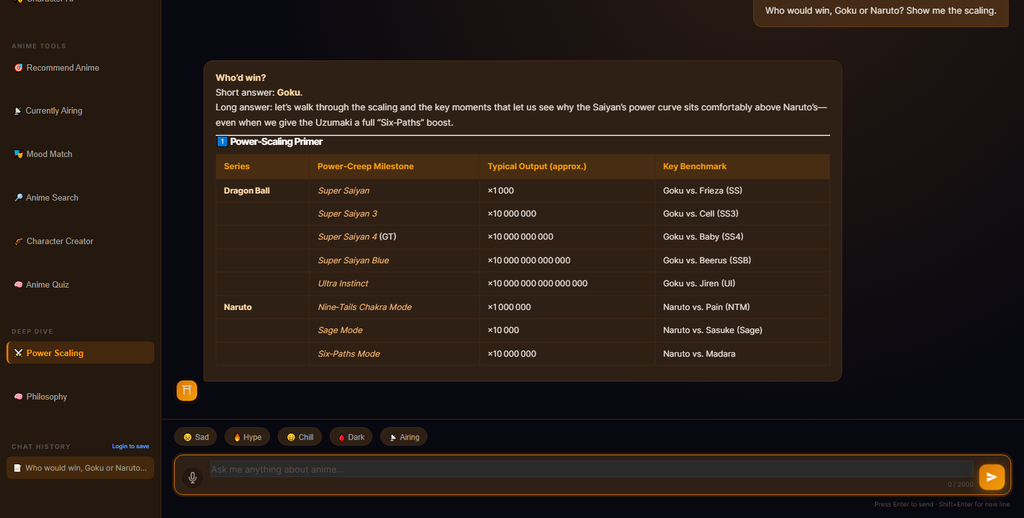
Doing this properly takes an hour of notes per fight, which is why most threads never get past the first paragraph of statistics. Otaku AI carries the bookkeeping. Its Power Scaling Analyst works from canon feats, character statements and established scaling, cites the specific moments it is relying on, and is built to stay fair and evidence-led rather than to pick the popular answer, which is the specific failure mode a matchup thread is most prone to.
The prompt is where the quality comes from, and there is a shape that works. Name both characters, give the version and point in the timeline for each, state the win condition, describe the arena, and list what each fighter knows going in. Something like a request for Gojo at full strength after Shibuya against Sukuna with Mahito merged in, Gojo losing if he cannot hold his technique, in a neutral arena, produces a usable answer. A bare request for who wins produces a confident paragraph, which is worse than nothing.
If you want a second opinion that does not come from your own assumptions, the Roleplay mode is genuinely useful for this. It becomes the character and stays in character, so Gojo and Sukuna will each describe their own plan for the fight in their own voices, and the gap between those two accounts is often where the interesting condition sits. Because the session carries the conversation forward and returns stored facts and preferences on later requests, you can build a matchup over several sittings rather than losing the thread of your own conditions. The interface is bilingual, which is useful when you want to check how a line was actually phrased in Japanese.
Then do the part no model can do for you. Watch the scenes, count the episodes, and check the feats against the timestamps. A matchup is a reading exercise wearing a spreadsheet’s clothes, and the tool is there to keep your notes straight rather than to replace the reading.
If you would rather test your own knowledge of the fighters before trusting a verdict, the anime character quiz ideas make a decent warm-up, and working out which anime character you are most like is the friendlier detour. When the argument has run its course and you want to put your own fighter on the page, building an anime character from scratch is the next step.
Keep reading