
Somewhere in your late teens or early twenties, every anime recommendation you received started converging. The same dozen names. The same three studios. The same person swearing by a series with a famously bad ending. Nothing is wrong with those shows. The problem is that your feed of recommendations has quietly become a loop: what gets recommended is what people already watched, and what people already watched is what got recommended to them. Escaping it takes different search habits, not more patience with the same ten threads.
There is a version of anime discovery that still works, and it is not hard. It is just much less efficient than the algorithm, which is exactly why nobody does it by accident.
Why the same dozen titles keep winning
Every recommendation system on the internet, anime lists included, is trained on attention rather than quality. AniList, MyAnimeList and every recommendation list built on top of them rank on the number of people who added a title, scored it, or marked it finished. That number is a real signal about reach. It is a very poor signal about whether something is good, and it is a hopeless signal about whether you would like it.
The mechanism that buries good shows is simple. A show that premieres on a Sunday night and lands hard gets a spike of members within a fortnight, and that spike does most of the work for the rest of its life. A show that opens slowly, or one that requires you to be in a particular mood at a particular hour, gets a fifth of those members and never climbs back. Once a title is buried, fewer people see it, so fewer people watch it, so the algorithm has less reason to show it to you. Twenty years of that will produce exactly the landscape most people complain about: a top fifty that barely changes, plus a million titles nobody has heard of.
There is a second, sneakier filter. Streaming catalogues and recommendation widgets mostly surface what has a marketing push, a simulcast, or a name people already recognise. A 2008 twelve-episode series that aired on a late-night cable channel in Japan has none of those. It is not that the algorithm decided it is bad. It is that nobody ever told the algorithm it existed.
How to read a database score without being fooled by it
Before you start hunting, it helps to know what the numbers on a listing page actually mean. A mean score on AniList is a weighted average, not a simple one, and a 7.4 from three thousand votes means something quite different from a 7.4 from four hundred thousand votes. The second one has survived a decade of people disagreeing with it. The first one might just be the week it was popular.
Episode count is the other field worth staring at. A thirteen-episode show and a two-hundred-and-forty-episode show both appear as single rows in a list, but they are entirely different commitments. A run that finished at thirteen episodes is a closed story. A show listed as still running after three years of no news is a different situation entirely, and the status field is where the database tells you so.
Genre labels are the least reliable field of all. Plenty of shows carry “Action” because they contain fights, not because the fights matter. Plenty carry “Comedy” because there is a running gag in episode four. When you search, treat genres as a loose filter, never as the answer, and lean on episode count and era instead. Both are fields you can actually sort by, which is the subject of the next section.
Three questions worth asking before you search again
Most people search “best anime” and then complain that the answers look the same. The query is doing almost no work. Three specific questions do far more.
What shape do you want? Length, format and era. Do you want something under thirty episodes, a film, something that finished before 2010, or something you can start tonight and finish before your holiday. Pick one and put it in the query. Every extra constraint removes candidates, and removing candidates is the entire point.
What do you want to feel? Not what genre, what feeling. Lonely, grieving, absurd, furious, sleepy. This is the hardest one to phrase and the most productive, because it rules out most of the list instantly.
What are you bored of? This is the question nobody asks. Tired of magic systems? Tired of school settings? Tired of a protagonist who is secretly royalty? Naming the thing you are sick of is worth more than naming the thing you like, because everyone has already named the thing they like.
Write those three down and put them in the same message. A single sentence containing all three is worth about twenty separate searches, because each separate search pulls you back toward the same popular cluster.
What the search mode actually returns
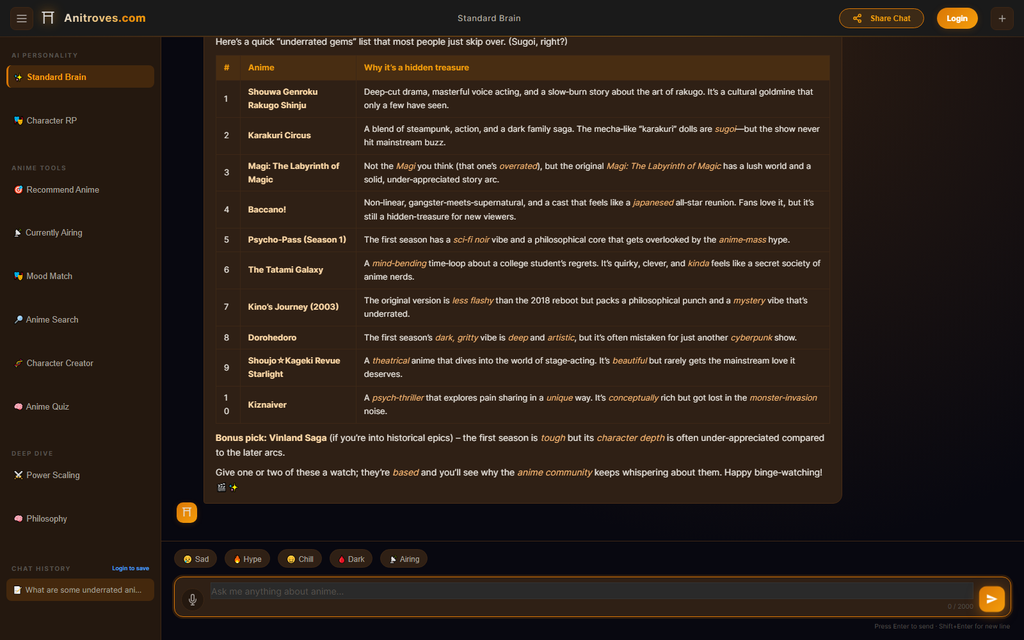
This is where a fixed-format answer helps more than a chatty one. Otaku AI has an Anime Search mode built around factual retrieval, and its output shape is deliberately boring: title, score, genres, episode count, status, pulled from AniList data when you supply it. That is not a limitation. When you are hunting for obscure titles, the last thing you need is a paragraph of adjectives about how emotional the show is. You need the record so you can sort it against the other records.
The practical workflow takes about four messages. First, ask for candidate titles under your constraints, without any score requirement at all. Second, take the six or seven names that interest you and ask for their records, which is where the mode earns its keep, because the episode counts and statuses are what tell you whether you are about to commit to twenty minutes or to two hundred hours. Third, ask about the ones that look like a single season rather than a commitment. Fourth, check your shortlist against something outside the database entirely, such as the studio’s own catalogue, because a lot of genuinely under-sold shows were buried by a production company rather than by the audience.
The one habit to avoid is asking for “hidden gems” in a single message. Ask instead for twenty-episode shows that started before 2010 and were made by a studio you have never heard of. You will get a usable list in a way that “hidden gems” never will.
Going backwards in time pays better than going forwards
If you want a genuinely different set of names, stop opening things that premiered last season. The recent end of any database is the crowded end. A few years back, the ratio of good shows to obvious ones improves sharply, partly because the obvious ones have been digested and partly because production has slowed down.
Take Mushishi. The first season ran from October 2005 to June 2006, twenty-six episodes, made by Artland and directed by Hiroshi Nagahama from Yuki Urushibara’s manga. It is an anthology: every episode is a self-contained case where a wandering bug expert investigates something odd and slightly sad. There is no team, no power system and no arc, which is exactly why recommendation algorithms keep skipping it. The studio that made it shut down in 2019, so there is not even a studio page pointing you onward. The sequel season, Next Passage, has twenty more episodes and the same structure.
Then there is Kaiba, twelve episodes in 2008 from Madhouse, written and directed by Masaaki Yuasa and aired on WOWOW late at night. It is about memory being stored in transferable chips, which means a character can wake up in a strange body with a hole in his chest and a locket, and the show is mostly about whether the person wearing a face is the person who owned it. It picked up an Excellence Award at the Japan Media Arts Festival. Almost nobody I know has seen it.
Twelve episodes is the other thing to notice. A short, complete show is a much better bet for a tired evening than a 200-episode commitment that might be a slow start. The search mode will happily show you a wall of complete thirteen-episode series if you ask for status and episode count in the same message.
Odd shapes, weird episode counts and stories told sideways
Some of the best under-sold shows are structurally odd, and structural oddity is exactly what recommendation systems filter out. Anthologies are the clearest example, because every episode has a different cast, so there is no character to build a fandom around. Mushishi is the textbook case, and so is any number of late-night one-offs from the early 2000s that you will never find by typing “best”.
The opposite of an anthology can work just as well. Odd Taxi is thirteen episodes, aired April to June 2021, produced by OLM Team Yoshioka and P.I.C.S., directed and character-designed by Baku Kinoshita and written by Kazuya Konomoto. The premise is a walrus taxi driver in a city of anthropomorphic animals who overhears his passengers’ conversations, and the structure is a mystery assembled entirely out of those overheard fragments. It has an extremely marketable hook image and a small, precisely built cast, and it is still the kind of title that needs someone to point at it.
What these shows share is a design that resists the popularity metrics. Anthology, loosely connected, side-character, short. Search on episode count and status, and on things like “ends with a complete story”, rather than on popularity. If you want something newer, the seasonal side of the same problem is handled by the guide to currently airing anime, because that one is a visibility problem rather than a quality problem.
Following a director off the shonen shelf
There is a second concentration worth knowing about. The most recommended anime in any given year come from a strikingly small number of studios, and the same handful of directors keep handing in another season of the same kind of show. That is not a complaint, it is a map. If you enjoy one thing a studio does, the rest of its output is a better search space than any genre list, because the studio has a house sensibility you already know you like.
The broader version of the trick is to follow a person rather than a genre. Frieren is the clearest recent example of a director dragging an audience into a genre they would not have chosen. It is Madhouse, adapted from the manga written by Kanehito Yamada and illustrated by Tsukasa Abe, and directed by Keiichirō Saitō, whose earlier work includes the police procedural you would not put on the same shelf. The result is a twenty-eight-episode first season that ran from September 2023 and sounds like a fantasy epic and plays like a very slow character study. Nothing in your history suggests you should try it. That is the appeal.
Writers travel too. Kazuya Konomoto wrote Odd Taxi and also wrote for the Monogatari series and for Ping Pong the Animation, the eleven-episode Madhouse series from 2014 directed by Masaaki Yuasa, who also wrote and directed Kaiba. If you liked the dialogue in one of those, the others behave completely differently on the surface and the same way underneath.
The practical version of this: pick one show you loved, find who directed and who wrote it, and search their names. It is the highest hit-rate search available and it takes about four minutes, and it is the one that gets you out of the twelve most-recommended titles without ever mentioning a genre.
One good show is not a foundation for the next one
Here is the mistake I made for about four years. I found something I loved, treated it as a category, and then searched for more of the category. Category search is how you end up with a watchlist of six near-identical shows and a sense that nothing else exists. The better move is to search for the opposite of what you just watched, or for a different reason you liked the thing you loved.
Concretely: if what you liked was a mood, search for a different genre that produces that mood. If what you liked was a writer or a director, search for their other work, including work in a different genre. If what you liked was a single character, follow the character out. That last route is worth spelling out, because it is how most of my own best finds started: one scene, one voice, one silhouette in a crowd, and no memory of the title. Working from a single remembered detail instead of a vague genre feeling is far more productive, and finding anime from one character or scene is the version of that search set up for it.
It also stops the disappointment problem. If you enter a new show expecting a specific feeling, you will rate it badly when you get a good but different show. Entering sideways, looking for a director or a form rather than a mood, tends to produce the shows that quietly rebuild your taste over a year.
When a hidden show is genuinely not worth your evening
Obscurity and quality are only loosely related. Some of what you will find is filler that happened to escape notice, some are adaptations of good manga that the animation did not earn, and some are shows that were cancelled or abandoned partway through, which is the one case you should actively avoid.
The tells are mostly in the record. A run that stops at an odd number of episodes with no continuation, a high episode count for what sounds like a contained story, or a studio with four credits in the last ten years are all reasons to check before pressing play. Cross-check the finale question directly if you are unsure, or read a review written by somebody who finished it. The other warning sign is a very high score on very few members, which usually means a small, enthusiastic audience rather than a hidden masterpiece.
The honest framing is that a bad obscure show wastes exactly as much time as a bad popular one, which is often more, because popular shows come with a warning. When you are three episodes into something and nothing is landing, quit. That is a normal outcome of a wide search, not a failure of taste, and the before-you-commit checklist exists for the shows where you want one more opinion first.
Building a watchlist nobody else has
Three habits have made my hidden-show hit rate roughly ten times better. First, keep the list small. Six titles, not sixty. A list you finish is a list that changes what you watch next month.
Second, sort your search results by something boring. Episode count ascending, or oldest first, or shortest first. Sorting by score or popularity is just the algorithm again. Sorting by length tends to surface shorts that never had a marketing budget, and shorts are where the unexplored stuff is concentrated.
Third, keep one slot in the list for something that could be terrible. Not a casual watch, a genuine “this could waste my night” pick, taken purely because it is in a genre or format you have ignored. That is where the finds actually come from, and it is also why a list of nothing but safe hidden gems is not really a search.
Otaku AI’s search mode handles this cleanly because it gives you records rather than adjectives, and because the session keeps your constraints in memory, so you can refine the same search over several messages instead of rewriting the prompt every time. If you want a bigger picture of what the tool can do across every mode, the walkthrough of all ten modes is worth ten minutes.
Once you have a list you are happy with, the next thing that tends to happen is that it gives you three more things to search for. For the process of turning one show into a dozen, the piece on finding anime similar to your favourite covers the mechanics, and if your problem is that everything currently available feels wrong rather than missing, picking anime by mood is the faster fix.
Keep reading