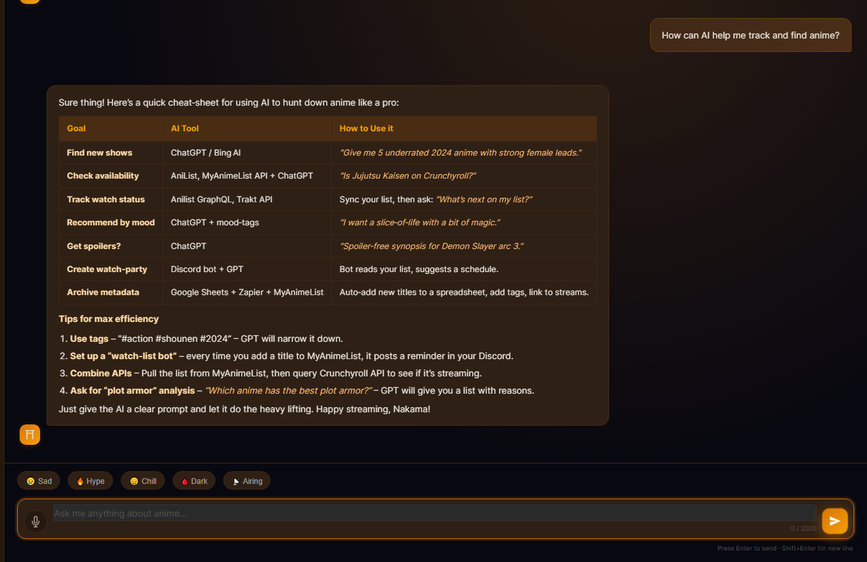
There is a specific failure mode in anime recommendations that anybody who has asked for one has hit. You name four shows you loved, you get back eight that are structurally identical to the ones you already finished, and you cannot explain why the answer is useless. The shows suggested are not bad. They are just the answer to a question nobody asked. What you wanted was not more anime like the last thing you watched, it was the next thing you would have found on a good day in 2014 when you were younger and had no history yet.
No public database can do that, because a database has no version of you in it. A personal guide is supposed to hold two things at once, the facts about the medium and the facts about the person asking, and keep them straight. Otaku AI is built as a full-screen chat assistant in the browser, free, with ten modes and a memory that persists across a long conversation. This is a tour of the parts that matter for finding and comparing anime, and of the unglamorous engineering that makes it answer the second time you ask instead of repeating itself.
What a personal guide actually has to do
Four jobs, and most tools do one of them well. Retrieve facts about a title, so you can check episode count and whether the story finished. Recommend, so you get candidates that fit rather than candidates that are merely similar. Follow, so you know what is on now and you are not three weeks behind. And reason, so that when two answers conflict you can get a position and a reason rather than a shrug.
The reason this matters is that the four answers are different in kind. Facts have a right answer and a wrong one. Recommendations have a good answer and a bad one and no way of knowing which you got until you watch it. Season information is true in April and quietly false in May. Reasoned arguments are the softest thing of all, because an argument about power scaling or themes is a matter of evidence and interpretation, and a tool that does not show its evidence is just being confident at you.
A personal guide is only useful if you know which kind of answer you are getting. That sounds obvious and almost nothing tells you. So the modes in Otaku AI are not a list of features, they are a promise about what shape the answer will take, and the honest way to use it is to pick the mode that matches the kind of answer you need before you type.
Starting from your taste, not from the catalog
The recommender mode is the one people reach for first, and the one where phrasing matters most. Answers come back as title and year with a one-line reason each, grouped by genre when there are several, which means the output is short enough to read and specific enough to argue with. A one-line reason is not filler, it is the whole value, because “great action” tells you nothing and “the pacing is the point rather than the plot” tells you exactly what you are signing up for.
What you should feed it is not a genre. Genres are the input that produces the eight structurally identical shows. Feed it the shows you finished and stayed up past one in the morning for, the ones you rewatch, and one show you loved that everyone else found boring. That last one is the most valuable input available, because taste and consensus diverge there, and a preference for a show outside the mainstream is the clearest possible signal about what to send next.
Then be specific about what you want changed. Not similar to, but the same strengths with a different setting. The same emotional register with more time spent on it. Something with a cast I have to care about rather than a protagonist I have to follow. Those are different requests that general recommendation engines flatten into the same answer, and stating the difference out loud is most of the work. The other half of the work is going back after you have watched something, because the second answer in a conversation is better than the first, and the fifth is usually best.
If you genuinely cannot say what you want, stop trying to describe it and describe the state instead. That is a different mode, covered below, and it works better than any amount of effort to invent a preference you do not have.
Checking the facts before you trust a recommendation
Every recommendation should be followed by a lookup, because the two failure modes are different. The recommendation can be a bad fit, or it can be a good fit described wrongly. Twenty-four episodes might be one cour of a long story or the whole thing, and the difference matters. “Completed” and “still running” are different decisions entirely.
The search mode is built for that. It returns factual data rather than an opinion, formatted as title, score, genres, episodes and status, and it uses AniList records where the data is supplied. That is the right shape for this because AniList tracks the things you actually need to check: episode count, format, airing status, genres, and the relation between entries, which is what tells you whether a second season is a continuation or a remake. AniList is worth having open alongside any conversation about anime for the same reason, and its API documentation is the reference if you would rather keep your own list than someone else’s.
Use the score column carefully. It is a popularity measure that behaves like a quality measure, and the two come apart constantly, particularly in older series where the score reflects who has bothered to rate a show rather than whether it held up. It is genuinely useful for one purpose: a high score on a show that is going to be hard to find conversation about is a warning, and a low score on something obscure is a signal that nobody will spoil you on it.
The habit worth building is one line of two. Recommendation, then search, then a decision. It takes forty seconds and it turns a list of titles into a shortlist with facts attached.
When you cannot say what you want
Some weeks you do not want a recommendation, you want something to sit inside for a while, and the two are different requests even though the same show can answer both. The mood mode is built for the first kind. It matches on emotional state rather than genre, recommends three to five titles, and explains the emotional resonance of each rather than why it is good.
That distinction is the whole thing. Explaining why a show is good is an argument about craft. Explaining why a show will sit correctly with the specific shape of your week is a different claim, and it is a more useful one, because the shows that solve a bad week are frequently the ones that would never appear on a quality list. A comedy that is technically mediocre and structurally restful is the correct answer and a recommendation engine will fight you on it.
Be specific about the mood, including the parts you would not normally say out loud. Numb rather than sad. Wired and unable to focus. Something to watch while doing something else that requires a bit of attention. The mode is better with an ugly, honest description than with a tidy genre label, and it is also the mode that benefits most from being asked twice in a session, since the second answer can take the first one seriously and narrow rather than restart.
One caveat. The people who need this mode most are also the people least likely to use it, because the point of a mood-based pick is that you cannot predict it. Write the sentence anyway. It takes fifteen seconds and it is the only mode here that will surprise you.
The season question and the four-column answer
Following a season is a different problem from finding something good. You are not searching, you are scheduling, and the information you need is small and current: what is on, who made it, how far along it is, and what it is. Anything else in an airing answer is opinion wearing a factual coat.
The currently airing mode is restricted to what is airing this season, pulled from live sources, and every line comes back in the same four columns: title, studio, episodes so far, genre. No adjectives, no recommendations, no “you might also enjoy”. That format is the reason it works, because a forty-title season becomes scannable in under a minute and the four columns are exactly the four things that change your decision. Studio tells you the production ceiling. Episodes so far tells you whether you are starting fresh or joining something in week five. Genre tells you how many of the bookmarks you just made are the same show three times.
The live part is the important part. A seasonal list written in March is wrong by July, and lists get cached, copied and repeated for years. This one is re-asked every time, and Groq’s compound models, which are the ones used for prompts that need live search, are built around tool access including web search and visiting pages, per their published documentation. In practice you can ask again in six weeks and the episode counts have moved, which is the only correct behaviour for a season that is still running.
Right now that means the fall 2026 slate, with new runs of Black Clover, The Apothecary Diaries and Aoashi alongside premieres like Firefly Wedding and Overgeared, as AniList’s fall 2026 season listing shows. You can get the full list with the studio attached in one query, then take the handful you actually have room for into the recommender and work out the rest.
The mode for arguing
Power scaling is the one place where anime conversation is genuinely polarised, and the reason is not that fans are stupid. It is that the question is under-specified. Who wins assumes a win condition, a point in the timeline, a rule set about whether blood magic and cursed energy interact, and a set of assumptions about how much damage carries across. Most matchup arguments are really disagreements about the hidden terms, conducted as if they were disagreements about the characters.
The power scaling analyst mode is built to fix that by refusing to answer unless the terms are stated. It works from canon feats, from statements made in the series and from scaling arguments, it cites the specific moments it is relying on, and it is expected to stay fair rather than pick a winner for you. The citation is the important part. An answer that says character A wins because of what happened in episode 213 of one series and a line in chapter 400 of another can be checked. An answer with no citations is a vibe.
It also helps that the mode is willing to tell you the question is bad. Ask it a matchup with two characters whose abilities are defined narratively rather than mechanically and it should come back with the argument that any result is an interpretation. That is more interesting than a winner, and it is usually true.
Use it after you have watched both, not instead. It is at its best when you disagree with it, because then you have to say why, and that is the fastest way to find out whether you actually have a reason. If you want the method rather than one matchup, the matchup guide covers the format and the failure modes in more detail.
The mode that tests what you actually remember
Quiz mode is trivia, and it is worth being clear about that because people assume it is a personality test. It is interactive, one question at a time, it scores you internally, and it mixes easy, medium and hard difficulty across several eras. Nothing more.
Which is exactly what makes it useful here, for a reason that took me a while to notice. A quiz does not tell you what you know, it tells you what you have stored, and those are different. You can know a plot and have no memory of it because you consumed it years ago in the wrong season of your life. You can have strong opinions about a character and remember almost nothing about the studio or the year, which tells you that you were emotionally in it and not really watching.
So play it as an audit rather than a game. Notice which questions you answer fast, since speed means strong stored opinion. Notice which eras you get wrong, since that usually means a childhood or a phase you have filed away. Notice the questions you argue with the options about, because the argument is more honest than the pick, and then take all of it into a normal conversation in the same session and ask for a character match built on the result rather than on the genre you usually name.
The timing of eras is a second, quieter signal. Easy questions on older shows and hard questions on newer ones means your knowledge is broad and shallow. The reverse means you have a few things you have watched closely, and the reverse usually means you will get more out of a recommendation than the average viewer, because you are going to notice when the writing is doing something.
The mode that makes something new
The character creator builds a full sheet: name, age, appearance, personality, backstory, powers or abilities, and the anime the character would fit in. On its own that sounds like a novelty, and for a while it was one for me, a party trick that produces a random swordsman and moves on.
It stops being a trick when you treat it as a thinking tool. The order of the fields is the argument. You have to supply a want and a failure before you can get an appearance back, which means the tool is forcing you to write the inside of a character before it lets you decorate the outside, and that is the correct order for anyone who has ever abandoned a character halfway through a design because there was nobody inside them. Characters as detailed as Yoshiyuki Sadamoto’s Evangelion work, and his own account of drawing the cast from Shinji’s point of view, covered in the Anime News Network interview from 2013, is a reminder that the design is an argument about the story rather than an illustration of it.
The second thing worth doing with it is iteration. Change the power, then ask for a story that would break because of it. Move the age up five years and see whether the backstory survives. Ask why the character would be in the room during the first scene of the show they were placed in, since that one question kills more weak characters than any amount of polish. It is the only mode here where the second and third answer are better than the first, and the reason is that you are building something rather than asking for something.
Two modes get ignored as much as this one did. Roleplay turns the assistant into a character and keeps it in character, with hand-written personas for a roster that includes Gojo Satoru, Ryomen Sukuna, Levi Ackerman, Eren Yeager, Monkey D. Luffy and a long tail of others, and for anything outside the roster it researches the personality and speech patterns first. It is a strange way to test whether you like a character and a very effective one, because arguing with a version of Levi about a decision is more revealing than ranking Levi on a list. The scholar mode is the other, reading a series against a real philosophical framework, existentialism in Evangelion, Nietzsche in Berserk, and it is at its best when you disagree with it.
Memory is the actual product
Every mode above gets better on the second ask, and that is the entire engineering goal. The full conversation is sent with each request, so the assistant is not starting from your last message, it is starting from the whole thread. More usefully, the session stores facts about you alongside the transcript and hands them back on later requests, so the things you said an hour ago, in paragraph four, are still available in paragraph forty.
In practice this is what makes a recommendation improve. You mention in the first message that you are tired of being handed another ten-year story with a slow start. Three recommendations later, when a candidate has a slow start, it is discounted before you have to say anything. Depth is adjustable in settings, which matters because the useful amount of memory is different for a five-minute search and a two-hour argument about whether a 2003 character could beat a 2018 one.
History is gated by login rather than by memory, and that split is deliberate. Logged-in visitors get their history saved to their account, so it follows them. Guests get history kept in browser localStorage, so it survives a refresh on that device without anybody having to make an account. You can chat either way and you are never blocked from starting. No provider keys are bundled, by the way, since all of the keys are entered by whoever runs the site, and the plugin is built with nonces, sanitisation and capability checks, with its REST endpoints restricted to same-origin.
If you want the specifics rather than my summary of them, the Otaku AI FAQ covers the common questions and the plain-language mode guide walks all ten in order.
Why it stays up when a model dies
Free assistants built on public model APIs fail in a boring and predictable way. Somebody exhausts a rate limit, the error is either swallowed or shown raw to the visitor, and the whole thing looks broken. For a tool whose whole job is being available when you have half an hour, that is the failure that matters, so it is worth knowing how this one is built.
There are three separate fallback chains, one for each kind of prompt. Prompts that need live search, prompts that need a table or a list, and general conversation get different models, because a model good at writing a chat reply is not automatically good at returning twelve rows in a fixed format. Live search uses Groq’s compound models, which support web search and page visits. Table and list work and ordinary chat run on the open-weight gpt-oss models at two sizes, one for the more demanding requests. A Mistral net sits underneath both, and when the whole Groq chain fails or rate-limits, the request falls through to Mistral and the visitor sees a normal answer rather than an error page.
Keys rotate on every response, up to ten Groq keys and up to ten Mistral keys, so a single exhausted key is not the same as a dead provider. A provider, model or key that fails gets quarantined until the next local day, which stops one bad actor from taking out everything behind it. There is a Continue button that deliberately retries with a different model when the answer is thin rather than technical. An OpenCode Zen fallback is available as well, and it can auto-discover up to six currently free models. None of this is visible while it works, which is the correct amount of visibility for it, but when somebody asks why an answer looks plainer than usual, this is the reason.
It also runs on a phone without feeling like a web form, which matters more than it sounds. Full-screen layout, tuned for phone, tablet and desktop, with safe-area handling for notches and the collapsing address bar in mobile browsers. Voice input through Groq’s Whisper speech-to-text, described in their speech-to-text documentation, so you can talk a prompt instead of typing it. Japanese and English on the same side. An input box that grows with what you type and tells you roughly where you are. A lock on the send button so a double-tap does not send twice. And a Share function that exports a range of the conversation as a high-resolution image with a live preview, which sounds minor until you have tried to screenshot a good exchange on a phone.
A real session, start to finish
So here is how an actual evening goes, in case the mode list felt abstract. You have forty minutes and no particular desire to think. You open the search mode and ask for the four shows that finished this month, get titles, episodes and status in a fixed shape, and delete two you already saw. You switch to mood and write the honest sentence about the week, get three to five picks with reasons about resonance rather than craft, and pick one you would not have chosen. You go to the airing mode and ask what is on, read the four columns, notice that two of your bookmarks are the same genre and delete one.
Then, if the second thing you picked is good, you do the thing that matters, which is go back to the recommender in the same session and tell it what the first thing was like, not that you liked it but what it was like. The tired-week framing has become a specific pattern, the specific pattern is now a preference, and the third answer is much better than the first was. Somewhere in that conversation you mention a character you have opinions about, and the quiz mode gives you a way to check whether the opinions came from watching or from reading a wiki page in 2019.
That is the whole method, and it is not clever. The value is not in any single answer, it is in having a place where the facts and the taste are in the same thread, where the thread survives, and where nothing depends on you remembering to search the right thing. Every guide on this site is an attempt to explain one of those steps in more detail, starting with building an original anime character and the modes that think about characters rather than titles, how to follow a season without drowning for the calendar side of the problem, and what to watch next for the version of this that is only about recommendations.