Ask ten people what to watch if you like One Piece, Naruto or Bleach, and you will get roughly the same six answers every time, listed in a slightly different order. That is not a conspiracy, it is a search problem. The three of them are all Toei Animation productions, all roughly 700 to 1,100 episodes of episodic adventure, all shonen, all frequently translated as “big three”. Type that description into anything and you get the same six. The interesting question is not what to watch. It is what you actually liked about the one you picked, because the three pull in genuinely different directions and the right answer changes completely depending on which one did it for you.
So this is four different conversations, not one list. Read the section that matches the show you actually finished, and skip the rest.
What One Piece, Naruto and Bleach each do that the other two do not
Before splitting anything up, it helps to be honest about the overlap. All three are long-form adventure shonen with a large ensemble, a power system, and a comedic streak. All three survived studio changes, filler arcs and reception swings. All three have fans who will argue about the last hundred episodes for a decade. At that level they are the same product.
The differences are lower down and more useful. One Piece is structured like a voyage. Islands are the unit, each one is a closed story, and the thing connecting them is a map you can nearly memorise. Almost nothing carries over except the crew. It is the most patient of the three and the least dependent on a good ending to the current arc.
Naruto is structured like a promotion. Every major arc moves a character up a hierarchy, grants a new capability, and usually costs them someone. The Village is the constant, and belonging to it is the actual subject. Betrayal, reintegration and second chances are load-bearing parts of the plot rather than incidental.
Bleach is structured like a job. Everyone in it has a specific role, an institution they report to, and a duty that outranks their wants. Its best material is about what duty does to a person, and its filler problem is a direct consequence of a world with a hundred named soulskeeper roles. If you stayed for the world and quit because of the ride, that is the split nobody warns you about.
Whichever of those three is your actual reason, one of the sections below fits. The generic list fits none of them.
If you like the world and the map
This is the One Piece column, and it is the one most likely to be answered badly, because the worldbuilding itch gets satisfied by the same shallow shows every time. What you want is a world where the setting is the reason to keep going, not a backdrop the characters occasionally fight in.
Start with Made in Abyss. It is thirteen episodes, July to September 2017, animated by Kinema Citrus from Akihito Tsukushi’s web manga. The entire premise is that there is one enormous hole, everyone wants to go down it, and every layer you descend into has its own ecology, its own rules, and its own specific horror. The curse of descending and surviving is that you are changed, permanently, and the show takes that literally. Thirteen episodes is also a genuinely unusual length in this conversation, which is why it is on the list at all.
If you want the reverse shape, horizontal instead of vertical, take Vinland Saga. Makoto Yukimura’s manga became a twenty-four-episode first season by WIT Studio in 2019 and a twenty-four-episode second season by MAPPA in January 2023, same director, and it is set in ninth-century England and Denmark with real place names, real dynasties and real sagas behind them. The second half deliberately abandons the power escalation of the first, which is either a problem or the entire reason to watch, depending on you.
A third option, if the appeal is curiosity about a strange culture rather than scale: Frieren: Beyond Journey’s End, Madhouse, twenty-eight episodes from September 2023, following an elf mage retracing a decade-old journey through ruins and a landscape that keeps changing hands. It is travel writing with a plot.
If you like the power curve climbing
This is the Naruto column, and the honest answer is Hunter x Hunter (2011), which is Madhouse, adapted from Yoshihiro Togashi’s manga, one hundred and forty-eight episodes, and the most complete shonen power system ever put on television. Nen is not just bigger, it is a resource you run out of, it has conditions, it has a cost, and characters permanently lose the ability to use it. Naruto’s escalation is unbounded and joyful. Hunter x Hunter’s is bounded and grudging, and that is the appeal if what you liked was the climbing.
The second pick is Jujutsu Kaisen, from MAPPA, and you should know that it is a deliberate argument with the Naruto model rather than a copy of it. Cursed energy is finite and explicitly compared to a fuel tank. The protagonist is physically weak for most of the first season. Then the show spends a long stretch making you watch the strongest character on the field from the perspective of the people who cannot touch him, and then that character is gone. If your love of Naruto was the curve itself, this will feel like theft. If it was the feeling of a technique finally working after a hundred episodes of failing, this is the same feeling with a harder budget.
Third option, and the one most people skip because the title sounds like a gimmick: Fire Force, twenty-four episodes in 2019 from David Production, adapted from Atsushi Ohkubo. Every firefighter has a flame, flames are inherited, and the plot is about what happens when people born into a job discover what the job is for. It has the escalation curve, it has a tournament, and it has the least interest of the three in pretending the fight is the point.
A word of caution. The power-curve section is where recommendations get most generic, because “big fights” is a cheap filter. If what you liked was not the escalation but the cost of it, the found-family section below is a much better fit than anything on this one.
If you like the found family
This is the Bleach column, or the Straw Hats one, depending on which show you were really watching. You like a group of badly matched people who end up being the only reliable thing in each other’s lives. That is a specific, under-served appetite, and the best example I know is not an action show at all.
Fruits Basket, the 2019 adaptation, sixty-three episodes across three seasons from April 2019 to June 2021, made by TMS Entertainment from Natsuki Takaya’s manga which ran in Hana to Yume from 1998 to 2006. A girl moves into a house with a family bound by a centuries-old curse, and each member of the family is hiding something that would put them out on the street. Sixty-three episodes of one person slowly finding out that everyone in this building is falling apart, and that being the person who stays is what fixes it. There is no power system. There is a family.
Then Dorohedoro, twenty-four episodes split across two twelve-episode runs from January 2020, MAPPA, adapted from Q Hayashida’s manga. Two people fall in love in the Hole, a lawless district where sorcerers from another world use residents as raw material, and the entire plot is the two of them trying to get back to the top floor to undo what was done to them. The found family is literally a gang with a squat. It is also extremely funny and gore-heavy, which nobody warns you about.
Third, if you want a group rather than a household: Beastars, a 2019 series from Orange based on Paru Itagaki’s manga, where a herbivore-beast detective works in a city of carnivores and slowly assembles the worst-possible team. Or Black Clover, Studio Pierrot, from 2017, which is pure found family: an orphan with almost no magic joins the worst squad in the kingdom and refuses to leave.
If you like the fights and not much else
Say this out loud and watch what the algorithm does. It hands you six shows with big fight sequences and no reasons to care about any of them. The category is not empty, but the good entries in it are rare, and the top of the list is a trap.
The best pure-action shonen available is Demon Slayer, ufotable, from 2019, adapted from Koyoharu Gotouge’s manga. It has a specific structural gift: the family dies at the start, the father becomes the thing they were hunting, and every arc is a training arc with a deadline. The combat animation is the best being produced, and the emotional reason to watch each fight is nailed down every single time. First season is twenty-six episodes, which is also a manageable commitment.
For the opposite lesson, Mob Psycho 100 from Bones, adapted from ONE’s manga, 2016 onward. It is a genuine action show with a genuinely good protagonist, and its entire second season exists to make you hate the structure you came for. If you want fights and nothing else, this might frustrate you. If what you liked about Naruto was the discipline underneath the fights, this is the one.
Third, and be careful with it: My Hero Academia from Bones, 2016, is a genuine long-form shonen with a real escalation curve and a school setting that earns its melodrama. It is also enormously derivative and about a decade into its run. Blue Lock, 2022, is the purest fight of all of them, and it is a soccer show where nobody passes. Both are fine. Neither is subtle, and neither is going to surprise you.
If you like the crew being idiots
This is the most underrated reason people finish a long shonen, and the most embarrassing one to admit, which is why it gets no recommendations. You liked the bit where a hyperactive idiot does something catastrophic and everyone around him has to physically stop him, and the show is funny precisely because everyone else is so tired of it. One Piece does this better than anything, with a character design chosen in part so that his reactions are legible from across a battlefield.
Three picks that do it on purpose. Nichijou, 2009, Kyoto Animation, original story by Tatsuya Ishihara, four girls at a school where the jokes are structurally impossible, including a protagonist who narrates her own life in the wrong tense. It is a complete twelve-episode comedy and it is one of the funniest things in the medium. Baka and Test, 2010, Silver Link, from the light novels by Kenji Inoue and Hajime Kanazawa, is the direct descendant of that joke: a school with an exam for murder, run by a boy who wants his test girlfriend killed, and the whole thing is played completely straight. And Gintama, Sunrise, 2006 onward, which is the most structurally unhinged of the three, since it abandons its own premise at the end of some arcs and picks it up again later.
A warning that costs people a season. Gintama is very funny and it is also a long shonen that gets serious, sometimes for whole arcs, in a way that reads as a tonal betrayal if you came purely for the jokes. Start with it expecting the jokes. Stay for the parts where it stops.
The episode count decides more often than the genre does
Here is the part most recommendation lists skip, and it is the part that actually determines whether you will finish. Hunter x Hunter is one hundred and forty-eight episodes. Vinland Saga is forty-eight across two seasons. Fruits Basket is sixty-three. Made in Abyss is thirteen. Fire Force is twenty-four. Demon Slayer‘s first season is twenty-six. Jujutsu Kaisen ships in short seasons of about two dozen.
Those are not the same product, and asking for “something like Naruto” hides that behind a genre label. Ask for a run you can finish in a season, or ask for one you can live with for two years, and the shortlist changes completely.
The number also predicts whether you will enjoy the show, more reliably than genre does. Long episodic shonen are built to be watched in long sittings, because the pacing assumes you are not paying close attention. A hundred and forty-eight episodes of an adventure series is not fifty hours of television, it is fifty hours of a story where half the value is in the running bits nobody rewinds for. A thirteen-episode show has to be tight, because there is nowhere to hide. If you have been failing to finish things lately, the episode count is the first variable to change, not the genre.
Asking for picks that are not generic
There is a specific phrasing that gets generic results and a specific phrasing that does not. The generic one is “recommend anime like One Piece, Naruto and Bleach”. The problem is not the tool, it is that the request has no opinion in it. It asks for the average, and the average is the six shows everyone knows.
What works is a request with a reason attached. “I liked the island structure of One Piece, where each arc is self-contained, and I did not care much about the fights.” “I liked Naruto’s training arcs and the way power was earned, not the power itself.” “I liked Bleach’s job structure, everyone having a role and a duty, and I want more of that and less of the hundred filler episodes.” Each of those returns a different list, and none of them returns the same six.
Two more things worth adding. Say what you are sick of, because recommendation engines weight exclusions heavily, and say the episode count you can tolerate, because most of them will not ask. If you get a first list that is still generic, the fix is not to ask again more nicely, it is to reject the list and say which entry was wrong and why. A recommendation engine that gets told “no, not that one, it is too cute” will do better next time than one that has never been told no.
What the recommend mode gives you
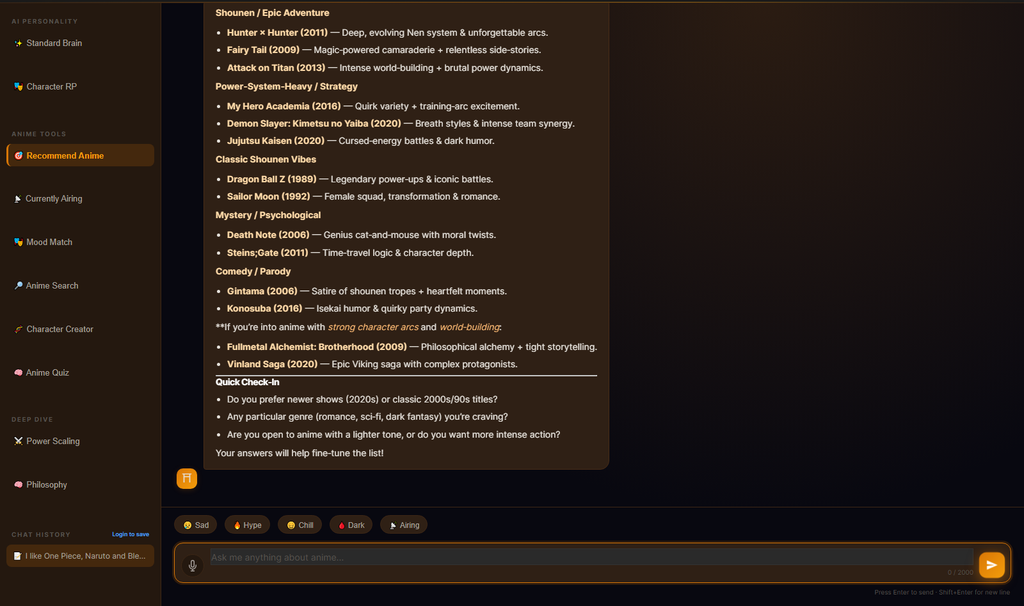
Otaku AI has an Anime Recommender mode whose whole design is closer to a film programmer than a search engine. The output format is deliberately compressed: title and year, then one line saying why it is on the list, and when there are several picks at once they are grouped by genre so you can see the reasoning rather than just the verdict. One line per title is enough, because the reason is the useful part. A recommendation with no reason is a guess with decoration.
The best use of it is a two-step process. Ask for a shortlist with your reason attached, five or six titles, no more. Then take the two that actually appeal and ask for records on those, or push back on the rest. What it will not do is give you twenty options, which is deliberate, because twenty options is how you end up back in the same paralysis that made you open this article.
Worth knowing about the session behaviour as well. Otaku AI keeps the conversation context across messages, so a correction in message five still shapes the answer in message six, and the preferences you state stay with the transcript if you come back to the chat later. That is what makes a slow, conversational way of getting recommendations practical, which is a different thing from a search box. If you want the full picture of what each mode is for, the walkthrough of all ten modes covers the rest.
The picks worth avoiding for these three specifically
A short, opinionated blacklist, because bad advice here is more expensive than bad advice elsewhere. The 2003 Naruto is a different show with a worse cast, a worse score and a worse story, and any list that hands it to a Shippuden fan is not a list worth reading.
Dragon Ball Super is the most common suggestion for all three and the least appropriate for two of them. It is fine. It is also a fifty-episode arc with a fumbled ending and a character line-up that quietly sidelines half the cast, and it does almost nothing interesting with a power system that was already solved. Black Clover in its first two seasons has a genuinely excellent premise, a strong rival and pacing problems severe enough that the well-meaning advice is to start at episode 24.
The pattern to watch for is a recommendation that describes a show as “like” one of the big three without naming a specific thing it shares. “Like Bleach” is meaningless, because Bleach is three shows. A recommendation that names the part it is matching, like “same job-structure and duty conflict, much shorter”, is one worth taking. That distinction is the entire reason this article exists, and it is the one to apply to every list you read after this one.
Once you have something started, the mechanics of turning it into a queue are covered in how to find anime similar to a favourite and what to watch after a series ends. If your instinct after reading this is that you would rather settle a character argument than find a show, the power scaling guide covers how those numbers actually get worked out, and the before-you-commit checklist is the thing to run once you have a candidate and a free weekend.