The credits roll, the last note fades, and you sit there with about forty minutes of evening left and nothing queued. This is the specific low that almost nobody warns you about, and it is not the same as being bored. You have just spent weeks or months inside somebody’s story, and now the shape of your evening has been removed without consultation. The search for what to watch next usually happens at exactly this moment, which is the worst possible time to make a decision.
The gap after a finale is a real thing
It is worth naming the feeling precisely, because naming it changes what you do. The gap is not the absence of a good show. It is the absence of a routine, and those two are solved by completely different things. If you are bored, a good show will fix it. If you are in a gap, a good show fixes about half of it and the other half is the part where you keep opening the finished show to check something is still there.
There is a second component, which is grief, and people are embarrassed about it. You have been following characters through something. If the ending was clean and the story was about the characters rather than the plot, you have effectively lost people, and the correct response is not to immediately substitute a new fictional relationship but to let the loss land and then go looking for something that fits the shape of what you had.
That distinction changes the search. Post-finale searching is not a genre search and it is not a quality search. It is a replacement search, and the input it needs is a description of what you had, not a description of what you want. Aiming at a gap is much less likely to work than aiming at the show you just finished.
Write down what you actually liked, first
The instinct after a great finale is to describe the show. “Really good shonen, amazing fights.” That is the least useful sentence available, because it is a compliment rather than a description, and it resolves to the same top of the list every time.
What works is narrower and more uncomfortable. Write down three things, and write them before you talk to anyone, because talking to someone about the show will make you repeat your summary of it rather than reconsider it.
One: the single moment you would screenshot. Not the best fight, the moment. One episode fifteen in a quiet scene, a joke that landed, a shot of a landscape, a line of dialogue. Two: the thing that annoyed you, including something small, especially something small, because small complaints are diagnostic in a way that large ones are not. Three: what you did while watching. The time of day, the context, whether it was background. If you are honest, the third one is frequently the most important and almost never the one people list.
Now you have a paragraph with actual content in it. From here, every recommendation conversation gets better, because the responder has something to work with other than a genre. I wrote this after finding anime similar to a favourite that the description is doing real work, and the same three lines are the raw material for a mood-based pick if your evening is going in a different direction entirely.
Matching the part you could not stop talking about
There is a difference between a show you liked and a show you talked about for two weeks afterwards, and it is worth finding out which one you just finished. People who gush after a finale are almost always gushing about one component, and that component is the searchable thing.
You loved the combat. You loved the politics between two factions where neither side is good. You loved the way it handled grief without ever mentioning the word. You loved a character voice, or a score, or the animation in one particular sequence. You loved the pacing, where nothing happened for forty minutes and then everything happened. Each of those points somewhere quite different, and “more anime like that” points nowhere at all.
When you have identified the component, the good news is that it broadens rather than narrows. A show whose appeal is a two-faction political dynamic is not limited to battle anime, and a show whose appeal is a specific kind of restrained visual storytelling is not limited to any genre. A lot of good post-finale recommendations are shows that share a component with your favourite and share nothing else, and that is exactly why they work. The genre match is the least interesting possible similarity and it is the one everybody asks for.
Four moves that produce better than genre
There are four reliable strategies, and they are worth knowing by name because each one needs different information and each one fails differently.
The first is the studio and director line. Studios have personalities that persist across directors, and production houses that keep making good work are a much more reliable signal than genre. Madhouse produced the first season of Frieren: Beyond Journey’s End, twenty-eight episodes from September 2023 through March 2024, and the house that made that is a genuinely different cut of anime from the one that made your favourite, whether or not the two are anywhere near each other in genre. The risk with this move is over-narrowing to one visual style, so pair it with a constraint that the studio is not allowed to meet the recommendation entirely on its own.
The second is the source material move. If what you finished was an adaptation, the source may be unfinished, and a partially-adaptated series is an underused category because it feels like settling. It also has a specific shape: you are entering a story partway through, with an adaptation’s framing and the original’s pacing, which is a real experience and a different one from starting from the beginning. The 2003 Fullmetal Alchemist is the case to remember here, since it diverged into its own story and stopped, and Brotherhood is the adaptation that follows Hiromu Arakawa’s manga all the way through, which is exactly why people who bounced off the first one often end up loving the second.
The third is the inversion. Ask for what your favourite deliberately was not. If you loved restraint and small stakes, the answer is loud and large. If you loved a sprawling ensemble, the answer is two people in a room. This works better than expected, because a description of a mood or a style is a partly open set, and a description of an absence is closed.
The fourth is the creator line, which is the strongest of the four and the least used. Anime creators have a recurring sensibility, sometimes within a genre, sometimes across two, and the jump is usually better than the safe genre match. Jun Maeda wrote Angel Beats, thirteen episodes from P.A. Works in 2010, after Clannad and Air, and did it again in a completely different register, which is a good demonstration that a creator’s thread can run underneath an unconnected surface.
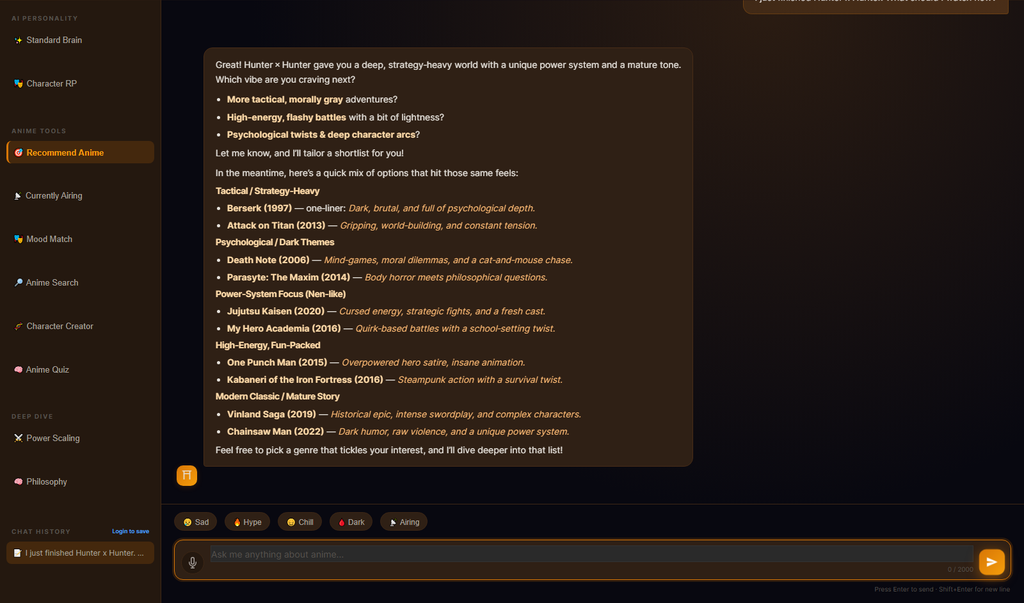
All four of those moves are things you have to know to ask for, which is the annoying part. Naming them out loud is what the recommender mode is for. Otaku AI will take a description of the show you finished plus any of these angles and return personalised picks, each one formatted as a title with a year and a single line of reasoning, grouped by genre when there are enough of them to be worth grouping. The one-line reason is the useful part, because you can immediately see which of your four moves the answer is actually using and adjust from there. Ask for a creator line, get a creator line, and if it is wrong, say which creator you meant.
The length of the next thing decides your week
After a finale, the default assumption is that the next thing should be big. This is usually wrong in the specific week right after a good ending, and the reason is that the good ending just spent your appetite.
People finish a long show and immediately try to start another long show, and then abandon it in a fortnight because the new one has none of the accumulated weight. The show you just finished had a hundred hours of your life in it. Nothing you start tonight has that. A shorter commitment is not a lesser experience, it is a proportionate one.
Some sizes for reference. Frieren’s first season is twenty-eight episodes. Hunter x Hunter in its 2011 Madhouse incarnation runs to a hundred and forty-eight, of which a large proportion belongs to the Chimera Ant arc, so it functions as several shows stacked end to end. Fullmetal Alchemist: Brotherhood is sixty-four episodes, produced by Bones and directed by Yasuhiro Irie, and it moves so fast that sixty-four feels short.
Pick the size from the week you are in, not from the show you are in. A bad Tuesday wants something under thirteen episodes. A holiday wants something with an arc you can finish before you go back to work. If you want a long commitment, start it deliberately and start it at the beginning, because being handed episode forty of a hundred and forty-eight is the fastest way to lose a viewer and the only genuinely indefensible thing a recommendation can do.
One habit worth starting now rather than in six months. Write down the three lines the moment a show ends, not the day you feel like it. Nothing in this article works if you cannot remember, a year from now, which moment you would have screenshotted, and that is the one thing you always can remember while it is still fresh. A fragment written down while it was still sharp is worth more than a description you try to reconstruct a year later, when you have already forgotten which of the five lines was the important one.
Reading the room on series that never really end
Some finishes are not finishes. A story stops and the discourse continues for years, and the “what now” question has a different answer, which is usually to wait and watch what the people involved do next.
Attack on Titan is the clearest recent example of the shape. The first season was twenty-five episodes from Wit Studio in 2013 and it is a closed story. The final season, years later, was produced by a different studio, MAPPA, under a different director, and the whole run ended in November 2023. Producers have spoken publicly about how long the gap was, and about how hard it was to find a studio willing to take it on. The entire thing spans a decade, which means the ecosystem around it, the fandom, the discourse and the source manga, is a better place to spend a post-finale week than starting something new.
The practical rule: if the show you finished is a long-runner, the highest-value moves are going back to the material it came from, picking up a differently-shaped story by the same creator, and following whatever the studio that finished it makes next. Ignoring all three and starting something unrelated is what produces the feeling that nothing afterwards is as good. The bar is not lower, the comparison is just unfair, and reading a source you already half-know is a genuinely different experience from the first time.
Worked example: after a hundred and forty-eight episodes
Say you have just finished Hunter x Hunter, the 2011 Madhouse version, all of it, including the parts most people drop. The obvious next move is another long shonen with a tournament arc. That is a fine move, but it is the genre match again, and there is a more interesting one available because you now know exactly what you liked and it is not the fights.
If the fights were the appeal, say so and ask for fight-heavy recommendations with a hard length limit, and accept that you will be offered Jujutsu Kaisen and that is fine. If what kept you going was the party as a group, with a new member joining every arc and the cast growing into something unwieldy and warm, then the useful description is a travelling ensemble with rotating membership, and that opens a much larger and better space. If it was the way the show spent three episodes on a single dungeon floor, then the description is pacing density rather than plot, and several excellent ninety-episode shows will match it and nothing in the battle-shonen shelf will.
There is also the source, which is the most underrated option here. The manga is long, it is finished, and it is illustrated in a way that a lot of people find a reason to revisit. Coming back to a finished story after a long adaptation is a different activity from starting one, and it is a good answer to the specific restlessness of having just consumed a hundred and forty-eight episodes.
Worked example: after a short original series
The opposite case. You have finished something short, original, and self-contained. Cyberpunk: Edgerunners is ten episodes, made by CD Projekt Red with Studio Trigger, directed by Hiroyuki Imaishi and released on Netflix in September 2022, and a sequel has since been announced, so the safest immediate advice is to leave it alone for a while rather than immediately starting a replacement.
Short originals create a peculiar gap because there is no source material to go to and no second season to wait for. There is only whatever you do next, immediately, with nothing pending. What works in that situation is to pick the opposite of what you just watched on two specific axes rather than on genre. If the show was relentlessly paced with music constantly pushing, then something nearly still, where a lot of the work is done by long shots and silence. If it was visually maximal, then something with a very small cast and a small number of locations.
Odd Taxi is a good candidate for a conversation along those lines, and for a reason that is not genre at all. Thirteen episodes, broadcast on TV Tokyo in spring 2021, produced by OLM and P.I.C.S. in a first-time collaboration, directed by Baku Kinoshita and written by Kazuya Konomoto. The premise is a taxi driver who overhears a series of conversations, none of which apparently connect, and by the end almost everything has. It is the opposite of Edgerunners in nearly every respect and it solves the same restlessness, because the two shows have almost nothing in common except that both are short, both are well made, and both go somewhere you did not expect.
When the whole genre suddenly reminds you of it
There is a specific and fairly common phase after a show that lasts weeks, where every recommendation reminds you of what you just finished, and nothing is bearable. A friend’s suggestion sounds like your show but worse. A poster in a shop looks like your show but is trying harder.
Two things are going on. The first is availability: the shows most similar to a popular one get surfaced, discussed and advertised, so the comparison happens whether you want it or not. The second is a genuine attachment, and pretending otherwise is silly. The correct response is not to ban the genre; it is to write down the three lines again and make sure the next request is built on the specific component rather than the surface.
The other thing worth doing is leaving the neighbourhood entirely for one show. Not permanently. Just one title that could not plausibly be recommended to somebody who had watched yours, which breaks the pattern and, more usefully, breaks the assumption that the good stuff is concentrated around what you already know about. Otaku AI will do this more reliably than a genre filter would if you tell it to, and the phrasing that works is blunt: “nothing that could be recommended to someone who watched the show I just finished.” Underrated anime you have probably not seen is the same idea applied to whole categories rather than single titles, and checking whether a specific title is worth the commitment before you sink an evening into it is the other half of that, and doing it while you are still in a gap rather than three weeks in is much cheaper.
The week after the picks land
The last thing worth planning is what happens after you get three suggestions and none of them is right. That is a normal outcome, not a failure, and the reason it is normal is that one show leaves a large space of possible successors and three guesses is three guesses.
Pick the closest of the three and start it, even if you are not certain, because certainty mostly arrives after episode two and waiting for it is a way of never starting anything. If it collapses by episode three, that is a cheap loss and it has produced a data point: you now know which of your three lines was the wrong one.
And if the gap is still there a fortnight later, that is the signal to stop asking for successors of the thing you finished and start asking a different question entirely. Sometimes the correct follow-up to a great show is not a similar show, it is a completely unrelated one picked by how you currently feel, or one you have been meaning to get round to for two years, or something small and short that takes a week. If you want a different mechanism entirely, building a proper next-watchlist from scratch is the cleaner place to start, and choosing anime by mood rather than genre is the one to reach for when you are still stuck on the same feeling rather than the same show.