
It is Sunday night. You have about forty minutes before you pass out, you have already burned twenty minutes of them on episode one of something you quietly do not care about, and somewhere behind the streaming tab you have eleven open browser tabs titled “best anime.” Every one of those lists opens with the same five titles. That is the moment this stops being a browsing problem and turns into a decision problem. You do not need more options. You need a way to describe what you want in language that something can act on.
Why the same four titles keep coming up
There is a reason every recommendation thread collapses into the same handful of shows. Fullmetal Alchemist: Brotherhood, Cowboy Bebop, Attack on Titan, Mob Psycho 100, and lately Frieren: Beyond Journey’s End. These are not bad picks. They are the consensus picks, and consensus tracks how loud a fandom is rather than how well something fits a particular person sitting on a sofa at half past midnight.
A list has no idea you are tired. It has no idea you already binged three battle-heavy shows this quarter and that you have quietly lost patience with training arcs. It does not know that you watched all twenty-five episodes of the first season of Attack on Titan, the one Wit Studio produced for the Mainichi Broadcasting System between April and September 2013, and that it did not land for you at all. Season one is a tight, mostly self-contained horror story, and plenty of people watch the whole thing and feel nothing. The list will still hand you the next season. Or the film. Or the manga.
Sorting by popularity is a fine way to find what is famous and a terrible way to find what you will actually finish tonight. Once you understand that a “best of” list is a ranking of reach and not of fit, the whole genre stops being frustrating and starts being mechanical. You are looking for the wrong artefact. What you want is a description of your own taste that is specific enough to be checked.
Five things you already know about your taste
Before touching any tool, dig out five facts you have never had to say out loud. They are all in your history and you have probably never once put them together in a sentence.
First, you know your dislikes better than your likes. You can name six shows that made you quit inside three episodes, and the reasons are consistent. Too much talking, no payoff, an overloaded cast, a protagonist who is written as clever instead of written as competent, one episode too long. That list is a specification. It is far more useful than your list of favourites, because it has fewer entries and more agreement between them.
Second, you know your real episode ceiling. Not the number you will tolerate in theory, the number you will tolerate on a week when you are tired. Some people sit through a hundred and forty-eight episodes of Hunter x Hunter without blinking; the 2011 Madhouse adaptation really is that long, and it is also the version most people mean when they say they have seen Hunter x Hunter. Other people fold at twenty-six. Both are fine. The mistake is asking for “a long show” and getting something that breaks you.
Third, you know the hour. Late night and a show that is ninety percent dialogue is a different experience from the same show watched at lunchtime.
Fourth, you know whether you want a story told to you or a world to live in. Those are not genres. They are pacing contracts.
Fifth, and this is the one people skip: you know which shows you quit and why. That is a short, specific, honest document about you. Write it down.
Name the problem before you ask for a solution
“What anime should I watch next” is a genuinely bad prompt, and it is the one everybody types. It asks a stranger to guess a person they have never met from a sentence with no content in it. The answer you get back is a list, and a list is the only shape a bad question can produce.
Compare it with this: “I loved the sound design and the atmosphere of Ergo Proxy, twenty-three episodes of it, but Re-l and Vincent as a pairing did nothing for me and I found the second half impenetrable. I do not want more slow cyberpunk. I want something with two people who cannot say what they mean to each other.” That is a real request. It contains a reference point, an exclusion, a length tolerance, and an emotional target. Any competent responder, human or otherwise, can work with it.
The practical version is a three-line prompt. Line one: what you just finished, and the specific thing about it that worked. Line two: the specific thing that did not, even if it was small. Line three: hard limits, meaning episode count, whether you have seen it already, whether you have read the manga, anything about your week. Three lines, about sixty words. That is enough for a genuinely useful answer and not enough for a generic one.
What the recommend mode actually returns
Otaku AI is a free, browser-based anime chat assistant that runs full screen on whatever device you have open, no install and no account needed. The default mode handles general anime conversation, but the mode built for this exact problem is called Anime Recommender. It gives you personalised picks, each one formatted as a title with the year and a single line explaining why it is on your list, and when there are enough of them it groups them by genre so you can scan rather than read.
That format matters more than it sounds. A one-line reason is a commitment. If the tool cannot justify a title in a sentence, the title probably should not have been in the list. The year in parentheses is useful in a way people underestimate, because it tells you whether a title is a suggestion to rewatch something you already love or a suggestion to start something new, and because an old show and a current one have very different commitment levels.
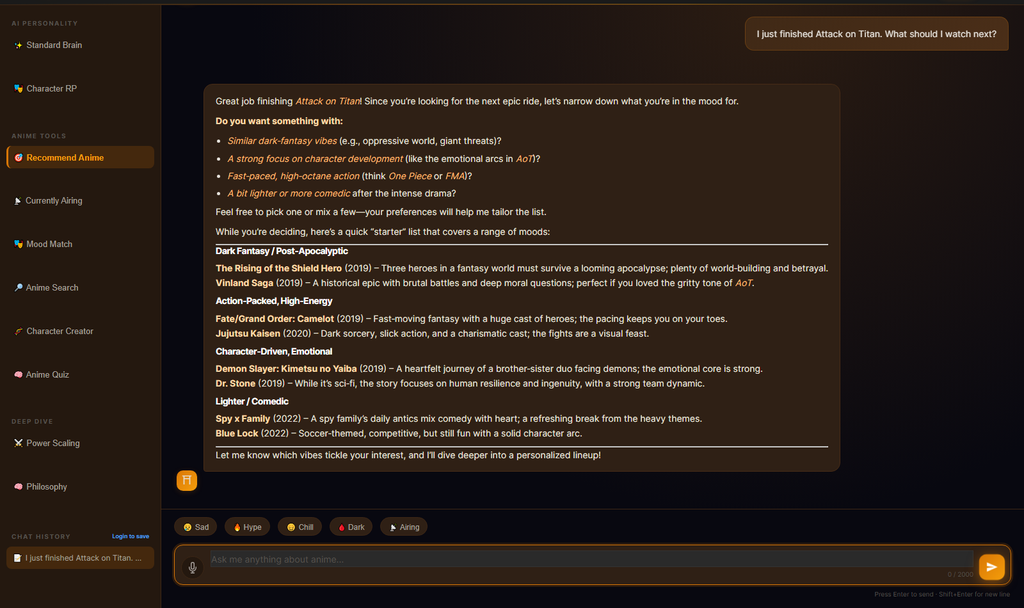
Two other things about the interface work in your favour here. There is voice input, so if you are lying in bed and cannot be bothered to type sixty words, you can say them. And the assistant is bilingual, so if the phrasing comes easier in the other language, use it. Neither of those is a gimmick when the whole problem is friction between you and the question.
Otaku AI also holds the conversation rather than treating each request as a fresh start. Facts you have given it in a session are stored with the transcript and brought back later, so a follow-up does not need your whole history repeated, and memory depth is adjustable in settings if you want a long thread kept. Guests get history held in the browser rather than on an account, which means you can do a recommendation session at one in the morning without logging into anything. For a free tool that is an unusually complete setup, and it is the part that makes a real back-and-forth possible rather than a single prompt and a list.
Prompts that get you a different answer
Here is what a good prompt looks like in practice, for a common situation. You have finished a 25-episode fantasy and you loved the world-building but the last three episodes annoyed you.
Something like: “Finished a 25-episode dark high fantasy recently, really liked the sense of a world with its own rules and its own history, disliked a last-act rush that undid most of the setup. Around 2009 to 2018 is fine. Nothing with a school setting. Nothing where the villain is the main draw. Give me things with a small cast and a place I would want to live in.”
Notice what that does. The negative constraints are doing as much work as the positive ones, and “nothing where the villain is the main draw” alone will remove a huge slice of the usual output. The year window keeps it from drifting into something where production values or storytelling conventions land in a different era from what you enjoy. “Small cast” and “a place I would want to live in” are the two clauses that push the answer somewhere less generic.
The same pattern scales up. If you are wading through recommendations in a long session, Otaku AI keeps the conversation and the facts you have given it, so the second prompt can simply be “more like the last one, but darker, and nothing over 30 episodes” without restating your whole history. You do not have to rebuild the context each time, which removes most of the reason people give up after one answer.
How to spot a generic answer in about four seconds
Read the reason line, not the title. Then apply the swap test: could this sentence be attached to almost any title in the list without changing a word? “A compelling story with great characters and stunning animation” fails immediately. “Structurally similar to what you liked, with the same overprotective lead and the same slow-burn rival dynamic” passes, because it is about shape rather than about quality.
Three more tells. Watch for reasons that are really paraphrases of your own prompt, because if your prompt was vague, echoing it back is the correct response and you should blame the prompt. Watch for a list where every entry has the same tone, because that usually means the tool is pattern-matching on one genre tag rather than actually reading your description. And watch for recommendations that are all from the same era or the same studio, which is a sign you accidentally described a mood in a way that maps to one production lineage.
The opposite tell is specificity. A good reason will name a structural similarity, a thematic thread, a difference you should expect, or a caution. Something along the lines of “slower than you might want in the first three episodes, but the payoff lands in episode nine” is genuinely useful information, and it is the kind of thing a lazy answer never bothers with.
Matching length and format to an actual weeknight
Length is the most underrated input and the one people feel silly about specifying. It is not silly. A twelve-episode show and a hundred-episode show are not different sizes of the same meal, they are different meals, and the wrong one will sit unwatched on your list for six months.
Some real numbers so the decision is concrete. Attack on Titan season one is twenty-five episodes. Fullmetal Alchemist: Brotherhood is sixty-four, produced by Bones and directed by Yasuhiro Irie, and it moves at a pace that makes sixty-four feel short. Hunter x Hunter, in its Madhouse incarnation, is a hundred and forty-eight episodes, of which roughly half belong to one arc, the Chimera Ant one, that stands on its own. Frieren’s first season is twenty-eight episodes, and Madhouse produced it as a two-cour, which is why it can hold a funeral scene in the first episode and still spend the rest of the run on character work that has no plot pressure at all.
Given a weeknight, that is a real decision tree. Under an hour available: one or two episodes of anything. A free evening: a complete short series, meaning something under fourteen episodes. A committed fortnight: a two-cour or a single-arc show. A holiday: the long stuff, and start it at the beginning, because the thing people resent most is being told a long show was great while being handed episode forty first.
When a short series beats everything else on the list
Short shows are the most underrated recommendation on any list, mostly because they are cheap to recommend and cheap to abandon, so nobody argues for them. Ping Pong the Animation is eleven episodes, came out in 2014 from Tatsunoko Production with Masaaki Yuasa directing, and it will give you more to argue about than most hundred-episode shows. Odd Taxi is thirteen episodes, aired in spring 2021 through a first-time pairing of OLM and P.I.C.S., and it is a mystery told in a world of talking animals, which sounds like a gimmick until you have seen how well the dialogue carries it.
Cyberpunk: Edgerunners is ten episodes. It was produced by CD Projekt Red with Studio Trigger, directed by Hiroyuki Imaishi, and released on Netflix in September 2022. It is a self-contained story rather than the first arc of something, it moves at a pace that respects a short attention span, and it has an ending rather than a cliffhanger. Its ten episodes are the entire run, which is the part to check before you commit to a night of it.
When your week is fragmented, short is not a compromise. It is the correct answer. A show you finish in a fortnight can still be rewatched, recommended to somebody, and thought about, which is a better return than a hundred and forty-eight episodes you abandon at sixty.
The five-line watchlist you will actually use
Recommendation systems fail because nobody records what they were told. You get a list of ten, you start one, you drop it for a reason you never wrote down, and in three months you cannot reconstruct why. The fix is not a complicated spreadsheet. It is five lines per show, kept somewhere you will look at.
Line one: title. Line two: what specifically made you keep going. Line three: what made you stop, or what nearly made you stop. Line four: the one-sentence pitch a friend would need to talk you back into it. Line five: whether you have read the source material. That last one prevents the single most common bad recommendation in the genre, which is suggesting an adaptation of something you have already consumed.
Keeping track of where things are is separate from remembering why. AniList is a reasonable place to hold the actual list, with scores, progress and status, and it keeps the mundane question of “what am I on episode four of” out of your head entirely. What AniList cannot do is hold the reason line. That belongs in your own words, in a note, or in a conversation with something that remembers the conversation.
When to ask again, and when to change the question
There is a point where asking the same question again produces the same answer with different punctuation. If three rounds of requests have given you five of the same titles, the problem is not the tool and it is not the database. It is that you described a preference in language that maps to a genre, and the genre is crowded.
At that point, change the input rather than the volume. Replace genre with structure, meaning “a show about two people who cannot say what they mean to each other” or “a show where the antagonist is right.” Replace era with format, meaning “a film” or “something that ends properly” or “a long one I can start tonight.” Put the specific episode you remember in place of the title, because a single remembered scene is a far sharper description than a series name, and there is a whole piece on finding anime from one remembered scene or character for that situation.
Two honest warnings. First, do not ask for something outside the medium. There is no live-action Dragon Ball adaptation you want and there is not going to be one. Second, do not let a list become a queue you are contractually obliged to work through. The whole point is to find the one thing that fits, then start it, then let the queue be wrong.
Also worth knowing before you commit: how to decide whether a series is worth your time before you commit to it covers the commitment check, and finding anime that are not popular is the move when the obvious answers have all been seen to death. If you have just finished something and the gap is the actual problem, what to watch after finishing a favourite anime handles that case, and picking anime by mood rather than genre is the tool for when you know how you feel but not what you want.