Ask a group of anime fans which character they are most like and you will get an answer in under a second, from everyone, including the person who was still thinking about breakfast. The reason is not flattery. It is that a well-built character is a bundle of decisions, and if you describe your decisions accurately enough, somebody has already made those decisions in a hundred and fifty episodes, and you recognise yourself in the outline.
That is the whole trick, and it also explains why the popular quiz results feel so accurate. Nobody is being told what they want to hear. They are being told what they already believe about themselves, restated in the language of somebody they trust. The result lands because the description fits, and the fit is real even when the framing is generous.
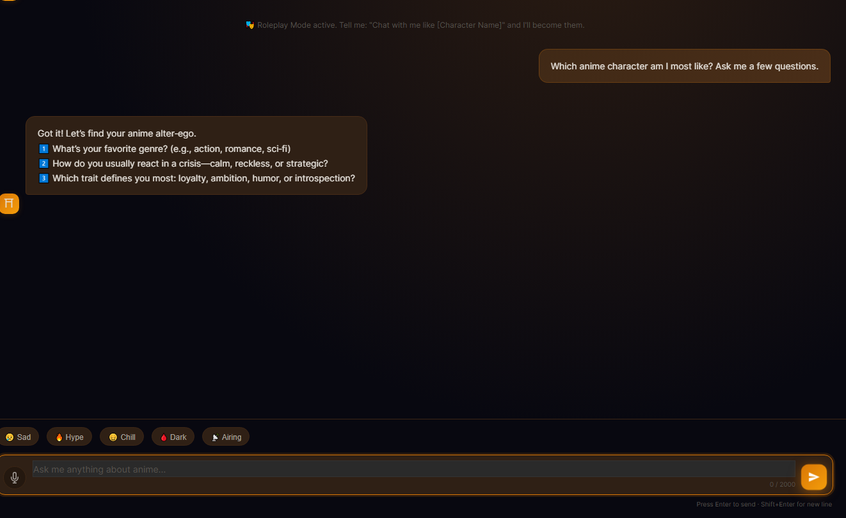
So this is a method rather than a test. Five behaviours, each of which you can actually check against your own history, and each of which narrows the field to a small set of characters. Once you have read the five, you can test yourself properly in Otaku AI, which is at otaku.animearray.site, and you will know what to type at it.
How you decide when everything is at stake
Forget how decisive you think you are. Look at the last genuinely bad decision you made and ask how long you took over it. Some people decide in a second and spend years explaining it. Some people build a table of options, consult two people they trust, wait for the right moment, and then do something nobody predicted, including them.
Both are anime protagonists. The first type resolves the scene inside ten seconds of the problem appearing, does not explain the reasoning, and walks into rooms that are objectively worse for everyone. Levi is the obvious example, and it is worth noticing how the show frames him: he is not cold, he is just operating on a shorter decision loop than the people around him. The second type thinks aloud, loses an argument they were winning by waiting, and tends to be played for tragic irony. Armin is the version who survives it. Thorfinn, in the later half of the twenty-four episode second season of Vinland Saga, is the version who is not sure he will.
The tell question is this: when you make a call, do you need to be right, or do you need to have started? Fast deciders and slow deciders are both watchable, and they fail in opposite ways, which is exactly why a cast wants both.
What you do when the plan breaks
Every character has a good week. The difference shows up the week the plan breaks, and there are two main answers. You change the plan. Or you become the plan, and keep going on momentum after the reason is gone.
The first group is the re-strategiser. Calm, a bit clinical, happiest with a whiteboard. Eren Yeager in the early seasons is in the second group and it goes badly for everyone, which is a good example of how the second answer usually works. The characters who change the plan are usually the ones who survive, and the characters who keep going on momentum are the ones the show eventually has to hurt, because momentum is not a reason and the script knows it.
There is a third answer, rarer and more interesting, which is to do the momentum thing on purpose while knowing it will not work. Guts in Berserk is the version that knows. He fights things he cannot win, in a body that is failing him, for a long stretch, and the show is about how much of that is stubbornness and how much is a promise he cannot put down. Whichever answer is yours, notice whether you are aware of it while it happens, because that awareness is exactly where the good anime characters sit.
How long you stay angry before moving on
This is the axis almost nobody asks about, and it separates more characters than taste ever will. Ask yourself when you last stayed angry at somebody who could not be fixed by an apology, and how long that lasted. Days? Years? Until something else replaced it? Until you were asked to do something with them again?
Some characters leave it. Giyu Tomioka spends Demon Slayer, a series about a boy refusing to give up on his sister, sitting on the fact that nobody was there for him, and he never resolves it out loud. He is recognisable precisely because the show does not make him say anything. The writing avoids the confession, so the audience carries it instead. Sakonji Urokodaki sent him away, and Giyu turned that into a rule about never being looked at, and that rule costs him the two people who are actually worth being known by.
Others stay angry on purpose, because the anger is load-bearing. Remove it and they have to decide what they actually want. Levi is a different case again, where the anger has already been worked through into a job, and the interesting part is that the job will not let him stop. If your anger rewrites what you do, the match is Giyu. If it has become a routine, the match is Levi. Both are worth watching, and they need different things from a viewer, which is the practical reason to work out which one you are.
Who you step in front of
Most people protect people. The interesting question is what happens to the protection when it starts failing, and whether the instinct is to be in front of the danger or to be between the danger and the person, which are not the same thing and produce very different shows.
Standing in front means you take the hit. Tanjiro Kamado is the version of this that works, because the show keeps asking him to be there and he keeps saying yes at a personal cost, and the story of Demon Slayer is eventually about the fact that the yes is killing him. Rock Lee is the version with a training arc bolted on, where the body is the limitation. Mikasa is the version who is so good at it that nobody can tell whether she is protecting anyone or just standing where the danger already is.
Between means you do not necessarily get hit, you make decisions, and the decisions are the problem. Erwin Smith in Attack on Titan is the clearest example, and the show is unusually honest about it, because the cost of his best plan is paid by people who trusted him, including his most loyal subordinate. The series itself ran across 34 manga volumes from 2009 to 2021 and passed 140 million copies in circulation by late 2023, and Levi is its most written-about character, including a prequel volume focused on how he got that way. He is the endpoint of the in-front type.
And there is a third group who protect by withdrawing, which is the hardest to read on screen and the most common in real life. They remove themselves before the damage lands, which works until somebody else gets hurt in their place. AniList’s character database is a reasonable place to check whether the character you think of here is a Shinji type or a Mikasa type, because the fandom tags will tell you before the wiki will.
How you talk to someone you have just met
Fourth axis, and the one most quizzes skip. Within about a minute of meeting a stranger you have already decided something about them, and the question is what your face does while that is happening. You watch. You talk first. You make a joke to break the tension. You mirror them. You leave early and process later.
Anya Forger is the joke option and the only one of these who is also a trained spy, so the joke turns out to be an investigation tactic. Kanao Tsuyuri is the mirror option, so much so that the story eventually has to break it deliberately to show she has grown. Kaworu Nagisa is the graceful option, and a fairly dark one once you know what he is for. Tuxedo Mask is the talk-first option with an agenda, and a lot of comedy characters run on the same engine without ever admitting it.
Say which of the five you are and you have already narrowed a cast of hundreds down to about thirty. The remaining narrowing comes from the other four axes, and this is why the quiz format works better when it feels like an interrogation than when it feels like a personality test. Nobody likes being asked directly what they are like in a group chat, but everybody will answer a question about a fictional situation if the framing is a fictional situation.
The five results people land on
Put the five answers together and you get roughly five shapes, and they are not archetypes from a roleplaying game. They are patterns that anime has actually produced in enough numbers to have names in fandom.
The Decider. You decide fast, you do not narrate, and you would rather be wrong quickly than right late. Levi Ackerman is the reference, and the Levi Ackerman character page is a decent place to see how much the fandom attaches to a person who says almost nothing. Eren Yeager’s late-series version is the loud one, and Eren’s father is the one who planned decades and told nobody. You will usually be happiest in something with a strong vertical structure, where a senior character makes the call and you execute it.
The Vanguard. You go first, before you are ready, because waiting feels worse than being wrong. Guts, Eren, Tanjiro, and Reiner Braun in the middle of Attack on Titan, who has been running on his own plan for seasons while telling everyone he is on theirs. You will either love or hate an adaptation, and you will be very loud about it in a group chat.
The One Who Stopped. You keep a grudge, or a grief, or an unanswered question, and you have organised your entire life around not resolving it. Giyu Tomioka, Shinji Ikari, and roughly every adult character in a Punnephi soft-boiled series. You will find these shows unbearable and then watch them twice, because being understood by a drawing is easier than being understood at home.
The Shield. You put yourself between the problem and the people, and you keep doing it after it stops working. Tanjiro, Rock Lee, Levi in his less functional seasons. You gravitate to shows where the group is the point, and you get uncomfortable when a show decides the group members do not need each other.
The Reader. You watch people first and speak second, and you are usually three steps ahead of the conversation and enjoying it. Anya, Kanao, Kaworu, Senku Ishigami, and every competent person in a horror show who is the only one who noticed the pattern. You tend to like shows that reward re-watching, and you are the person in the group who asks why the ending had to go that way.
Why your first instinct is the wrong answer
Here is the bias that ruins most of these results. When you are asked which anime character you are most like, you do not answer from your behaviour. You answer from your taste. You pick the character you would most like to be, and quizzers hand you a character who is a good person with good powers, and you recognise yourself in the combination of flattering things.
Run the test. Write down the character you would claim, then write down what you actually did the last time a plan broke. If the two descriptions use different vocabulary, the second one is the answer. Almost nobody is Levi. Rather more people behave like Levi than say they do, because being decisive feels like competence even when the decision is bad.
Second bias: the loud character. Gojo, Bakugo, Luffy and Sukuna win these quizzes because they are memorable, and memorability gets confused with recognisability. Third bias: the protagonist. The lead of a show is written to be a point of view, not a person, so a lead can be a much worse model of you than the character who opposes them. Keep your claimed match, but score your behaviour against the opposing one as well.
What Otaku AI actually asks you
Now the practical part. Otaku AI has a quiz mode, and it is worth being precise about what it is: interactive trivia, one question at a time, scored internally, mixing easy, medium and hard difficulty across several eras. It is not a personality test and it will not hand you a match on a plate. What it does is the thing you actually need, which is ask you a series of questions about the shows you have watched and make you commit to answers.
Play it straight and use it as an audit rather than a game. Notice which characters you answer about quickly, because a fast answer means strong stored opinion, and strong stored opinion is a personality signal. Notice which eras you get wrong, because that usually means you watched them young and your memory built a different version. Notice the questions where you argue with the options, since the argument is more honest than the pick.
Then take the result into a normal conversation in the same session. Otaku AI keeps the transcript and holds on to the facts you give it, so you can say plainly: here are the characters I got wrong about, here is what I always pick first, here is how I behave when a plan collapses, and ask it to build the match from that. Because the context is already there, you do not have to explain Attack on Titan to somebody who has read the room, and you get an answer grounded in your actual history instead of a generic result. If you want to compare the answer rather than accept it, ask for three candidates with the case for and against each, then go and read the thing.
Turning a match into something you watch
A result is only worth the five minutes it takes to follow it up, and the follow-up is where most people quit. Do not watch the show the match came from. Watch two episodes of the show where the character came from, then read how the show treats them at their worst, not their best. The best-version of a character tells you what a series wants, the worst-version tells you what the series is about, and the gap between those two is where every good character lives.
Then run the reverse. Take the character you claimed by instinct and check them against the one your behaviour matched. If the two are nothing alike, that is a genuinely interesting result and it is worth asking why in a group chat, which is where most good arguments about anime happen anyway. Otaku AI also has roleplay personas for a roster of popular characters including Gojo Satoru, Levi Ackerman and Sukuna, and putting a few questions to a character that matches you is a rougher and better test than any quiz.
If you would rather check the data yourself first, building your own anime character from scratch uses the same behavioural axes, and the anime character quiz ideas article has material for writing questions of your own. The personal anime guide to Otaku AI covers what to do once you have a shortlist, and the power scaling guide is where the Vanguard types end up.