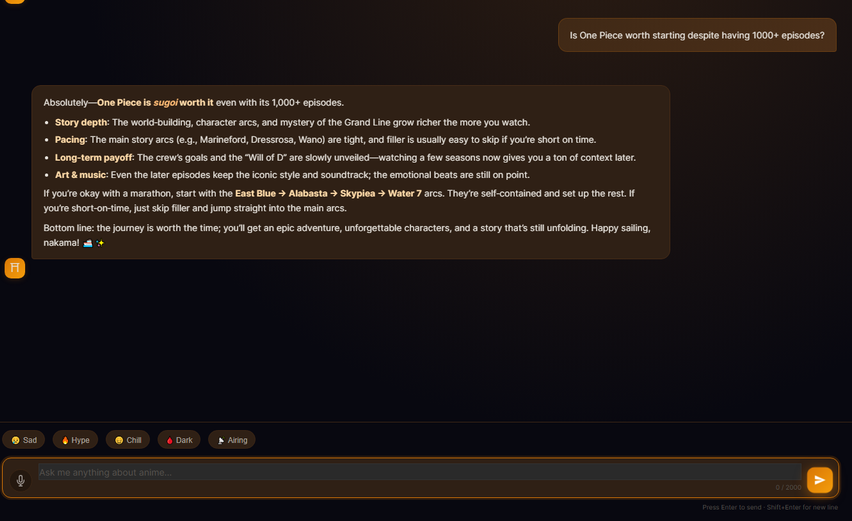
The question is not whether the anime is good. You cannot know that yet, and anybody who tells you they can is guessing. The question is whether it is a good bet, and that is a completely different calculation. It depends on how long it runs, how it paces, how many people you have to hold in your head, and whether you are the sort of viewer who can leave at episode six. All four are knowable before you press play.
Most people get this wrong by looking at the wrong number. A hundred episodes sounds enormous and a two-cour split of a story that is still running sounds small, and those two situations are not comparable. Below is the framework I use, and it takes about five minutes of checking per show.
The episode count is not the commitment
A hundred episodes is only a hundred episodes if you watch them in order, in sequence, and feel unable to stop. Almost nobody does. The realistic number for most people is three shows on rotation, which means a long-running show sits in your queue for years at a cost of nothing and starts in the background of your life rather than the foreground.
For scale, the One Piece anime passed 1,177 episodes in early September 2026 and has been running since October 1999. Nobody is expected to watch that. People watch an arc, then a specific arc, then a flashback arc, and the show has been engineered by its own creator to be enterable that way. The hundred-episode commitment is a myth that keeps people away from series they would actually love.
What you are really committing to is the next four to six episodes, because that is how far ahead you will have watched before you find out. So judge on that basis. Would I watch six more episodes of this on a Tuesday, having already seen the first one, knowing I can stop there if I want to. If the honest answer is that you are not sure, that is fine and normal, and it is also the moment the next few sections start doing work, because the variables that decide it are all checkable in advance.
Count the season, not the franchise
Before anything else, work out what a single season of this thing is, because that is the unit of commitment. Most seasonal shows are twelve or thirteen episodes, occasionally eleven or ten. Frieren ran to 28 episodes in its first season and then to a deliberate 10 in the second, which finished in March 2026, and both of those are comfortably watchable commitments because the second one ends properly. The second season of Vinland Saga is 24 episodes and takes the story somewhere completely different from the first, which is a good reminder that the number to look at is the one in front of you.
Then establish whether it is one cour or two. A two-cour split means roughly six months between the halves, and that gap is where most people quietly fall out. If the show’s structure depends on momentum, a six-month gap will cost you more than a hundred consecutive episodes would. If it is a case-of-the-week mystery or a self-contained story per episode, the gap changes nothing.
The last check on length is whether the story is finished. A story that has ended has a real endpoint, and a story that is still being published may not get one for years or may get one you dislike. Adapting a completed work tells you the shape of the whole thing. Adapting a work that ran for a decade tells you that the anime is choosing, and the choosing is where the pacing problems live.
Pacing is the real variable
Given the same episode count, two shows can feel completely different in how much time they demand. Pacing has three parts, and all three are visible before you start.
Episode length is the big one. Six-minute shorts and half-hour specials are not the same viewing object as a 24-minute episode, and a show made of six-minute episodes can be watched in the time a typical show takes to do two episodes. A late-night slot, a streaming exclusive, a children’s timeslot and a prestige slot all have very different default runtimes and none of them advertise it, so check before you commit. If you are tired at the end of the day, an hour of television is a very different proposition from twenty minutes of it.
Then there is what happens inside the episode. Action shows spend their minutes on movement, which is easy to hold but leaves you with less plot per hour. Dialogue and interiority shows do the reverse, and they punish being distracted in a way an action episode does not. If you plan to watch on a phone while commuting, that is a strong signal toward the first kind and a strong warning about the second.
Third is episode structure. A show with a self-contained plot each week can be watched in any order and sampled freely. A show built as one long story cannot, and a show with a tournament or a conspiracy is somewhere in between. This is also the thing that decides whether the first episode tells you anything at all, and it is worth asking before you invest the evening.
How many characters have to live in your head
This is the variable that predicts failure better than length, and almost nobody thinks about it. Ten named characters is fine. Thirty is a chore. Sixty with a family tree, several aliases and two separate timelines is a project, and if your attention drifts for a week you will spend the first three episodes of the next one working out who anyone is.
So find the count. A character list on a wiki page will give you the number in ten seconds, and the number of main characters is usually what a reasonable adaptation supports. Note the ones with aliases or transformations, because those are the ones that cost you. Eren Yeager has a handful of identities and a younger version with a different hair silhouette, and a show that asks you to track both while also running a two-generational backstory is a different kind of television from one where the cast is nine people and you know all of them.
There is a genre pattern here too. Ensemble comedies and long shonen runs are cast-heavy by design and they are wonderful for exactly the kind of viewer who enjoys holding a large cast. A tight mystery, a workplace show or a sports drama with one team is cast-light and much lighter to watch. Neither is better. They are different amounts of work, and the only mistake is picking the wrong one for a week when you have no energy for bookkeeping.
Genre is a commitment, not a vibe
Choosing a genre is agreeing to accept its conventions. Sit through three episodes of an isekai and you have seen the contract: the protagonist is a person from our world, the world is written to be bigger and safer than ours, and a good number of the jokes will be about the character not understanding local custom. If that is not a thing you enjoy, no amount of quality rescues it, and the writing is usually strong enough that you will feel the mismatch clearly by episode three.
The same goes for the heavier end. Battle anime ask you to watch people in pain fight repeatedly, sometimes for a hundred episodes. Romance with an explicit genre tag is not somebody falling in love, it is a specific rate of progress with rules about when the confession can happen. Cyberpunk futures assume a world where the worst institutions are the functional ones, and a lot of people find that exhausting after a while. Sports anime are almost relentlessly good, and they are also relentless, with a game or a match in nearly every episode.
My own test is whether I have finished anything in that genre this year. Not whether I like it in principle. If the answer is no, treat the new show as a second bite at a genre you have already declined twice, and expect the friction to be about the genre rather than the show.
What it asks of you thematically
Length and pacing are logistical. The thing that actually makes people abandon anime in the final third is that the show started asking a question they did not want to be asked. Long shonen in particular grow up: the first half is a tournament and a training arc, and the second half is usually about something much heavier, and the audience that signed up for competence tests has to decide whether it wants a story about inherited violence and the price of winning.
So check the themes before the premise, and check them early rather than at the finale. Ask what the show wants to argue. If it wants to argue something you already agree with, you will find it rewarding. If it wants to argue something you find indefensible, you have a choice to make now, and a horror anime that is bleak for four hours and then bleak on purpose for twelve more is a different experience from one that resolves.
Two flags help. A very long first season with a short, closed ending is usually a contained story, and the thematic risk is lower. A show that keeps expanding, adding factions, backstory and time travel past the moment where the premise got answered, is telling you that the middle is the destination. Some people love that. Nobody is neutral about it.
The drop test
Before you start, decide whether you would be able to stop at episode six and lose nothing. Some shows you can. A case-of-the-week detective show, a workplace comedy, a sports series in a season of matches, a family or slice-of-life show. You will have had a complete experience and can come back to the next arc whenever, with zero loss.
Some shows you cannot, and the difference is entirely about whether the plot is still arriving. A story that assumes you saw episode four, a mystery that depends on a withheld fact, a tournament bracket, a mystery box that was opened in episode two and has been driving everything since. These shows convert your attention into a debt. Once you are four episodes in, stopping means finding out the ending later, or never, and that feeling is the mechanism behind most of the guilt-driven completion in the medium.
This is a genuinely useful filter, because it separates shows by how you will watch them rather than how good they are. A show that fails the drop test is not a bad choice, it is a different contract, and you should accept the contract explicitly. My own rule is that anything failing the drop test has to be something I would watch anyway, with no reservations, because I am going to finish it.
The filler question
For adaptations this is the practical risk, and it is worth ten minutes of research. The useful number is the ratio between what the adaptation has covered and what the source has published, since a series deep into a long manga often has more source material than it can animate in a season and pads to fill. The reverse is also a risk: a series that has consumed the whole source and is being stretched to a second season has nothing left to adapt except the ending.
Two concrete examples of opposite situations. Demon Slayer’s first anime season was 26 episodes by Ufotable and ran from April to September 2019, while the manga did not finish serialising until May 2020, so the anime was working through available material with a studio that could afford to make every episode dense. The same article records the sequel film Mugen Train becoming the highest-grossing anime and Japanese film of all time, which tells you what that pacing bought.
On the other side, any show that announced a second season weeks after the first one finished rather than years later is telling you the source is finished and the studio has budget. That is not automatically a bad sign, but it is the situation where a new arc gets written for television, and those arcs are more variable than anything adapted from material that already existed.
Using Otaku AI’s search and recommender modes
Here is where the checking stops being manual. Otaku AI has a search mode that returns factual data rather than opinion, formatted as title, score, genres, episode count and status, drawn from AniList records when the data is supplied, and AniList tracks those things per series properly, including format and whether a show is still running. The AniList API documentation is the reference if you want to build your own list instead.
That matters because the five data points are exactly the ones this framework needs. Episode count gives you the size of a season. Status tells you whether the story is finished. Format tells you whether you are looking at a film, a short run or a long series. Genres give you the convention check in section five. Score is the one you should mostly ignore, because it is a popularity measure dressed up as quality, but it is useful as a rough signal for whether the show is well known enough that people will have finished it, which affects what happens if you abandon it.
Then use the recommender mode for the part a database cannot do, which is matching rather than retrieving. Ask it for series that share a specific attribute rather than asking what is good. Give it the length, the genre and the episode structure, and add the thing you are hoping not to hear, which is a show with fifty main characters or a story that gets darker in the second half. Recommendations come back as title and year with a one-line reason each, grouped by genre when there are several, and the reasons are the part worth reading, because a bad reason tells you the show is not the one you asked for. When something does land, finding anime like a favourite is the follow-up, and the gap after a finale is the one most people actually get stuck in.
Because the whole conversation is kept in memory, you can do this in one pass. Tell it the handful of shows you loved and the two that put you off, name your episode budget, and ask for candidates. The preferences you gave earlier are still in the transcript, so the answer improves as you talk. Give it the constraints first and the taste second, in that order, because the constraints are harder for it to guess and the taste is the part it will assume without being told.
The five-minute check before you press play
Put this together into something you can run in five minutes, per show. Get the episode count of one season and whether the story has ended. Get the per-episode runtime. Get the main character count. Read one synopsis sentence and check the genre labels against what you have actually been finishing. Decide whether it fails the drop test, and if it does, whether you want it that much anyway.
Then the last question, which is the only one that matters. If the show is available and you have no idea, you will start it. That is fine and it is what the medium is for, a hundred and fifty episodes of somebody else’s life is a cheap afternoon by any serious measure. The framework is not there to talk you out of things. It is there so that when you abandon something at episode eleven you know whether it was the show’s fault, your energy, or a genre you have quietly decided against, and which of those is the thing to change next season.
Once a show is on, the what to watch next guide covers the search afterwards, the currently airing guide covers the seasonal case, and the personal anime guide to Otaku AI ties every mode together.