
You have watched something you loved, you have told people about it twice, and the response to “you should watch that too” has now given you back the same four suggestions for the fourth time. Hunter x Hunter if you liked Hunter x Hunter. Fullmetal Alchemist if you liked Fullmetal Alchemist. That loop is not the tool being broken. It is the tool doing exactly what you asked, which was to find things in the same genre, when what you actually wanted was the other nine things that made your favourite work.
Genre matches are the least useful answer available
Ask any recommendation system for a battle anime and you will get a battle anime. You will get one with the same studio tendencies, one with a similar art style, and one that a popular list already ranks highly, because those are the features that are easy to sort on. They are also the least predictive. Every battle anime is similar to every other battle anime at the level of genre, and the difference between one you will love and one you will drop at episode three is almost never the genre.
It is worth being honest about why. Genre is a coarse, widely agreed label attached by a database or a marketing department. It compresses an enormous range of shows into one word, and a show can be a battle anime and still be nothing like another battle anime in anything you actually care about. Twenty-five episodes of a self-contained horror story that happens to contain a giant creature is a completely different experience from sixty-four episodes of a travelling adventure with an ensemble cast and a comic streak, even though both sit in the same shelf.
So the first move in getting a genuinely different answer is to stop using the genre word. The second is to accept that the useful similarities live at the level of structure, pacing, tone, and the specific thing that made you finish the last episode. Those are describable. They just are not the words a database is built around.
Name the part you actually loved, not the show you watched
Most people can name a favourite and cannot name why. Ask someone what they loved about a show and you get a paraphrase of its premise, because naming the reason means confronting something more specific than the premise. That specificity is the entire ballgame.
Working through the list of things a show can be loved for: the atmosphere and the sense of a place existing whether or not the plot is moving. The writing, in the sense of dialogue that sounds like people rather than like exposition. The structure, meaning a particular kind of escalation or a particular pacing rhythm. The characters, in the sense of one specific relationship rather than the cast as a whole. The visuals, meaning a particular animation style or a particular use of colour, silence or framing. The discomfort, meaning a show that made you feel genuinely unwell. The company, meaning you enjoyed it because of who you watched it with.
Pick one. If the honest answer is “the writing,” you now have a filter that no genre tag can express. If it is “a specific relationship,” you have something even sharper, because you can describe what that relationship does that you liked. Ergo Proxy is a reasonable example of the trap. People tend to describe it as a cyberpunk show, which pushes you towards the obvious neighbours. But what most people who love it will point at first is a specific dynamic between two people who cannot be honest with each other across a twenty-three episode Manglobe production that ran on WOWOW in the first half of 2006. That description narrows the field enormously and for the better.
Three scenes are worth more than the title
This is the single highest-value technique and almost nobody uses it. Instead of describing the show, describe three specific moments and ask for what shares them.
What you end up with is something like: “I am trying to find shows that have the same three things going for them. One, an ending scene where the music stops and a character sits alone in a room after everyone else has left. Two, a mid-series episode with no plot at all that is basically just two characters walking. Three, a moment about fifteen episodes in where a serious person says something ridiculous and everyone keeps a straight face.”
That is a specification, not a genre. It cannot be satisfied by the same four titles you have already been given, because those three moments are narrow and specific and unlikely to co-occur. It also forces the recommendation to justify itself against your actual experience rather than against your summary of it.
Use the same structure for negative scenes too, because exclusions are more reliable than inclusions. “I did not like the training arc in the middle, I did not like a romance that pulled two established characters into a different register, and I did not like when the show explained its own symbolism out loud.” Those three lines will delete more wrong answers than any positive constraint you can write.
The five questions matchers skip
When a tool or a friend gives you a similar show, there are five things you can ask about it that turn a name into a decision. This is the part everyone skips, and it is why lists keep failing.
One: how is the pacing distributed? A show can be the same total length and be completely different in shape, front-loaded with a strong opening and a slack back half, or slow for six episodes and then relentless. Two: how many characters actually carry the story? Two leads is a different object from a twelve-person ensemble. Three: what is the show’s relationship with the source? Original, adaptation, sequel, remake, or continuation, because that determines whether you can safely read ahead. Four: what is the actual subject? A show about the cost of immortality is not a show about monsters, even when it has a lot of monsters. Five: what does it demand of you emotionally at what hour? A show that will wreck you at one in the morning and a show that will wreck you on a Sunday afternoon are different commitments.
Ask those five questions and a list of eight titles becomes a ranked, decidable set of four. The recommendations did not get better. You just stopped treating them as interchangeable.
Pair recommend with search so the facts are not guesses
There is a habit in this community of accepting uncertain numbers. Somebody says “the second season is twelve episodes” and it gets repeated forever. Half the time it is right. The failure is cheap, but it is also completely avoidable, and the reason it is avoidable is that two different kinds of question need two different tools.
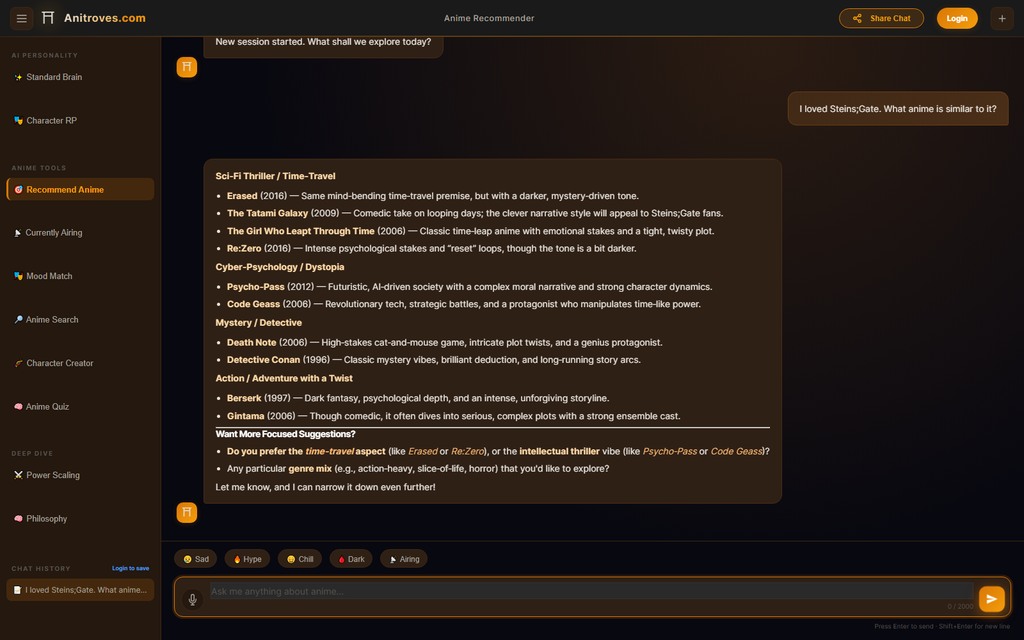
Otaku AI splits those up on purpose. The Anime Recommender mode handles the open question, producing personalised picks with a title, a year and a one-line reason, grouped by genre when there are enough of them to warrant it. That is the mode for “what else is like this.” The Anime Search mode handles the closed question, returning factual data in a fixed shape, title, score, genres, episode count and status, and using AniList data when you supply it. The AniList database behind it is the same one most of the community uses, so a search answer is checkable rather than something to trust on vibes.
Pair them and the workflow becomes clean. Recommend first, to get a wide set of candidates. Then search the two or three that appeal, to get the episode count, the studio, the status and whether anything is unfinished. Then run the second recommend prompt, narrowed by what the search told you. Three prompts, and you end the session knowing exactly what you are starting and roughly how long it will take, which is the thing most recommendation conversations never deliver.
Worked example: something tactical and grim
Say your favourite is a tactical survival horror with a squad dynamic and a season structure that resolves an arc cleanly. Attack on Titan is the obvious comparison point, and worth being precise about it: the first season is twenty-five episodes animated by Wit Studio and directed by Tetsuro Araki, covering roughly the first thirty-four chapters of Hajime Isayama’s manga, and it is a closed story with an ending. The final season, years later, was made by a different studio entirely, MAPPA, with a different director.
Now ask for similarity without naming the genre. “I want military-survival tension, a cast of soldiers who are all competent and all frightened in different ways, and a story that is willing to kill anyone including the people you like. Not a school setting. Not a superhero morality play. I want the enemy to make strategic sense.”
What that filters out is as important as what it leaves in. It removes the school-ensemble power systems, the villain-of-the-week comedy, and anything where the antagonist is the draw. What remains, when the reasons are specific, tends to share structural features rather than surface ones: small siege-like premises, a chain of escalating bad choices, an arc-per-season structure with real closure at the end of each one. Odd Taxi is a legitimate suggestion from that description, thirteen episodes of it in spring 2021, produced by OLM and P.I.C.S. together for the first time, because a story told entirely in confined conversations between a handful of people who each know a fraction of what is happening generates exactly the wrong-suspicion pressure you are describing, even though nothing about it resembles a mech.
That is the point. A good answer is allowed to look nothing like your favourite on the surface. A bad one cannot look like anything else at all.
Worked example: something quiet and warm
Now the opposite case. Your favourite is a low-stakes slice-of-life where the pleasure is in competence at a small task. Yuru Camp fits, twelve episodes from C-Station in winter 2018, built entirely around cooking, folding, cycling and looking at Mount Fuji, with a plot so thin you could argue about it for a week and lose. Or Beastars, twelve episodes in autumn 2019 from the CG studio Orange, which starts as a campus drama about a wolf on a stage crew and turns into something about self-loathing and predation and it is very funny, which nobody warns you about.
The genre word here is “slice of life,” which is nearly useless, because it contains Yuru Camp and it contains a show about a man slowly realising he has ruined his life. What you actually liked is a texture: competent people doing a physical thing, unhurried, with consequences that stay small.
Ask in those terms and the answer changes. “I want slow craft, tasks that are genuinely shown rather than summarised, and stakes that never escalate past the people in the room. Twelve to twenty-four episodes. If something sad happens it has to be small and private, not a tragedy.” That specification, run through the recommend mode, will produce a different list from a “good slice-of-life anime” prompt, and the one-line reasons will be the place to check the fit, because a reason that says the show is mostly talking will let you skip a candidate without watching four episodes to find that out.
One caution specific to this branch of viewing. A show can share the texture and completely miss the tone. Check whether you want comedy in the background or underneath, and whether you are happy to watch something with genuine sadness in it, because those two preferences will each delete a third of the plausible list.
When similar is exactly the wrong thing to want
Some shows are so tied to their genre that the closest matches are exhausted before you start. If your favourite is a very long battle shonen, the honest answer is that its direct competition is a handful of series and you have probably already seen most of them. Chasing similarity there is chasing a shrinking set.
That is the moment to switch the axis rather than the genre. Pick a dimension your favourite is unusual on and search there. A show is unusually long, unusually quiet, unusually violent, unusually gentle, unusually stylised, unusually episodic, or unusually tied to a historical period, and the similarity that matters may be nothing like the one you would have searched for by name. If your favourite’s appeal is that it is 148 episodes of detours and lore, then the useful neighbour is not another 148-episode shonen, it is a show with that appetite for digression at any length.
Another version of the same idea: if you loved a specific sequence rather than the show, the sequence is the search term. A four-minute animated sequence can be discussed in terms of what it does, and shows that do the same thing exist, they are just not labelled with the name of the show the sequence came from.
Building a shortlist you can finish inside a month
Recommendation piles are a form of procrastination. Sixty titles in a list equals zero titles watched, and the pile produces the specific guilt of knowing you have a large amount of something available and none of it seen.
Force a small number. Three candidates, ranked, with the reason each was chosen written down in your own words, and a hard rule that if none of the three has started within a fortnight you do not extend the list, you change the input instead. Three is the right size because it is small enough that you can hold an opinion about each one and small enough that starting one is a decision rather than a project.
For each of the three, record four lines. What it is and how long it is. What part of your favourite it is supposed to echo. Where it deliberately differs, since the differences are where your enjoyment will actually happen or not happen. And whether it is adapted, so you do not read the source and then resent the adaptation for taking its time.
Keep the surviving list somewhere you will glance at. Three titles with a reason attached is a document you can act on. Sixty titles without one is a bookmark folder, and bookmark folders have never once turned into a night of watching something new.
Why you keep getting the same five titles back
Three rounds, five identical suggestions, and the reasonable conclusion that nothing works. In that situation, the useful diagnosis is that your description of your favourite is sitting too close to its genre. Every synonym you have tried still resolves to the same shelf, because the words are genre words wearing ordinary clothes.
Move down one level of specificity. Genre becomes structure, structure becomes a specific scene, and a specific scene becomes a description of what the show does rather than what it is about. At that point the same five titles stop being able to satisfy the request, which is exactly the point. You are not trying to get a different answer from the same question. You are trying to ask a better question.
It also helps to name the show you do not want. “Not a school story, not a isekai, not anything where the power system is the plot” narrows a space in one sentence, and the absence you care about is usually a much clearer signal than the presence. Most of the time, if you cannot get a good answer, the fix is one more exclusion rather than one more enthusiasm.
Where this goes next depends on what you are still stuck on. If the problem is that you have no shortlist at all rather than that your current one is thin, start with what anime to watch next and build the list before worrying about similarity. And if the memory you are working from is one image rather than a whole show, identifying anime from a single scene or character is the sharper tool. What to watch if you like One Piece, Naruto, or Bleach goes at the specific case of a fandom with an exhausted supply of obvious answers, and the wider Otaku AI guide lays out every mode, which is worth ten minutes if you intend to keep using this for more than one question.