It is eleven at night and you are trying to remember the name of a show you watched once, seven years ago, on a laptop with the subtitles half off. You have got a girl with long purple hair. There is a rabbit costume involved. You think it was a dub. You are going to spend the next forty minutes describing this in increasingly strange terms to a search engine that wants keywords, and you will end up on a list of anime that merely have talking animals in them.
The memory you keep is a snapshot, not a title
People treat this as a failure of memory. It is not. It is a description working normally. What survives a decade of not watching a show is not its plot or its cast, because those are large and abstract. What survives is a handful of images, and images carry an enormous amount of information that the title does not. A costume, a colour, a room, a gesture, a shot.
This matters because the search you are running is the wrong shape. Every title-shaped search assumes you have a title. A small number of you do. Most people have an image and have been trying to reverse a lossy compression by memory alone, which is why the usual advice, “just Google it,” fails. Google wants a string. You have a picture.
So the fix is to give up on the title and describe the picture instead. Concretely: a character detail, a setting detail, a plot shape, a visual or animation detail, a line of dialogue if any of it stuck, or an emotional impression. Any one of those is a real search term. “A rabbit costume” is a better search than “show with a girl,” and the difference is not subtle.
Starting from a character rather than a plot
Characters are the strongest starting point available, and the reason is that they are the most reliably remembered thing about an anime. Vaguely recalling a story is easy. Recalling that a specific person was in it, with a specific look, is much rarer and therefore much more diagnostic.
Write the character down as a physical description rather than a role. “A swordsman” is useless, there are thousands. “A swordsman with a scarf covering his mouth who fights holding a wooden sword” is a description of a specific character, and specific characters have specific shows attached to them. Height, build, hair colour, the single most unusual item of clothing or accessory, an injury, a weapon that behaves oddly, the way they stand, and above all the one detail that is genuinely strange enough that you would remember it.
You also have the option of starting from a voice. If you can remember a Japanese voice actor doing a specific performance, or an English dub voice, that is one of the narrowest possible search terms, narrower than a character description and much narrower than a genre. Dubbing casts are small, and if you can pin even two actors you have effectively identified the production year and studio.
There is a second, less obvious advantage to character-first searching. When you find the character, you get the show for free, and then the character hub becomes a place to check the details, which often brings the rest of your memory back faster than searching would. Characters with dedicated pages tend to be the popular ones, and a memory that resolves to a popular character is usually accurate, whereas a memory that resolves to nobody is usually about a less famous show and deserves more care.
Starting from one shot with no context
Sometimes what you have is not a character and not a plot, it is a single shot. A specific image that has no business being that memorable: a fight on a rooftop in the rain, a long corridor with one light at the end, a train crossing a bridge at sunset, an entire episode that is one conversation in an empty room.
Describe shots the way you would describe a photograph. Where is the camera. What time of day. What is the weather doing. How much of the frame is the person. Is anything glowing, is anything in motion, is there water or a crowd or a machine. This produces sentences that are long and unhelpful to a keyword search and enormously helpful to something that can reason about them, which is the whole reason to use a conversational tool for this instead of a database search box.
Add the negative details as well, because they are half the description and nobody uses them. What era of animation, roughly, is the art style. Is it modern digital, or older and flatter, or heavily stylised, or deliberately ugly in a way you would recognise. Is it colour or was it mostly black and white. Was the framing unusual, were there long static shots, was there almost no dialogue. Negative visual constraints delete more candidates than positive ones, and they are the ones you are most certain about.
Starting from a voice, a song, or an opening
Music fragments are underrated as search terms. Openings and endings get lodged in memory separately from everything else, sometimes for years, and they are often the only fragment left after everything plot-related has gone. A hummed ten seconds is a real identifier, and it narrows the field faster than a paragraph of plot description.
The same applies to a voice. If you remember a performance rather than a face, that is a stronger lead than most people realise, because a small number of voice actors have distinctive enough deliveries that a description of the delivery can identify a show. Describing a performance as “an older man who sounds permanently tired and slightly amused” is more useful than it sounds, and pairing it with any visual detail you have left is a strong combination.
One more category worth naming: the credit. A studio, a director, a network bumper, a licensing deal. Some people remember not the show but the fact that it was one of the last things a particular channel did before it changed hands, or that it was the one show they watched on a service that has since shut. That kind of memory is rarer but it is nearly always correct, and it is much easier to search than a plot.
What search mode actually returns
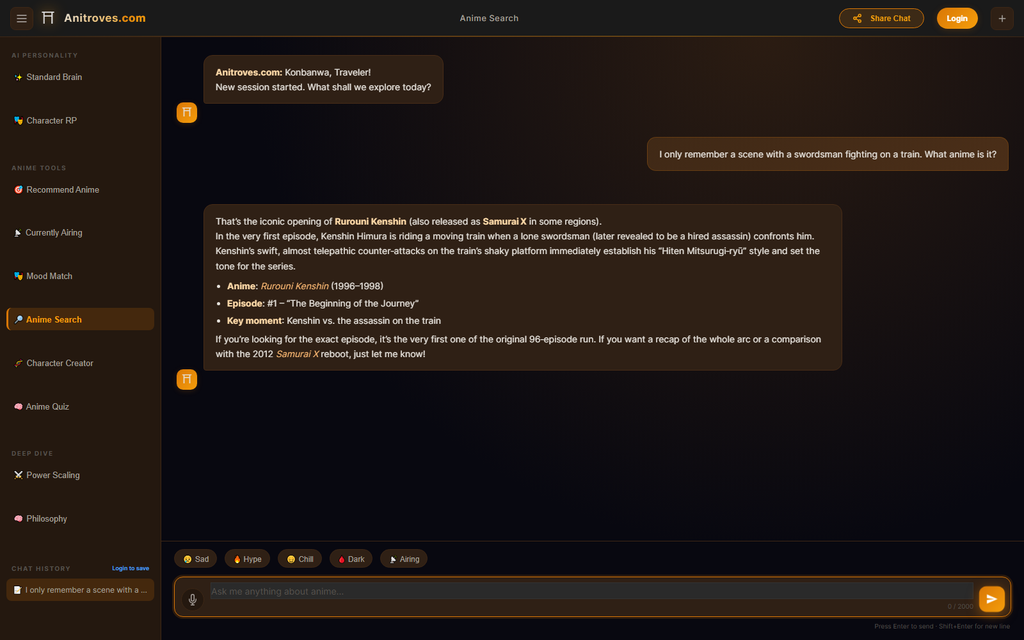
Otaku AI separates the two jobs here, and the separation is what makes this work. The Anime Search mode is the factual one. It returns entries in a fixed shape, title, score, genres, episode count and status, and it uses AniList data when you supply it, so the numbers are real database numbers rather than generated ones. You can check any of them yourself, because the AniList API documentation is public and the site is free to use without an account.
What that gets you is verification, not discovery. The moment you have a candidate list of three or four from a conversational description, search mode is how you stop guessing. Is it twenty-three episodes or one hundred and fifty. Is it finished or still running. What year. What genres. Whether it is an adaptation of something you have already read. All five facts, in one line per title, and every one of them checkable.
Otaku AI runs these as genuinely separate tools rather than one answer that mixes invention with data, which matters more here than anywhere else in a session. A conversational description will happily produce a confident wrong studio name; the search output will not, because the numbers come from the database. Two modes, one conversation, and the discipline of using the second one to check the first is the entire method.
Two practical notes. Describe first, search second; the search shape is bad at guessing but excellent at confirming. And if you are on a phone, or on a sofa, or otherwise unable or unwilling to type, there is voice input built in, running on Groq’s speech-to-text, so the whole conversation can be done out loud. Keys for that come from the Groq console, which is where a site owner would get them.
Why vague descriptions fail until you sharpen them
Most failed attempts at this are not failed searches, they are under-specified questions. “Old anime with a cool girl” produces nothing usable, and it will keep producing nothing usable no matter how many times it is run, because it does not contain enough information to exclude anything.
Sharpening is mechanical. Take the vague description and add one constraint from each of five categories. Physical: a colour, a costume, an object, a location. Structural: how many episodes, roughly what year, animation style. Narrative: a job, a relationship, a situation, a number of central characters. Sensory: the opening shot, the music, the weather, the amount of dialogue. Emotional: the single word for how it made you feel.
Any two of those will transform the result. The reason is mechanical too: each added constraint deletes candidates, and the value of a search is entirely in the deletion rate. One vague constraint deletes almost nothing. Four specific ones delete most of the field, and what is left is short enough to recognise from a title.
There is a version of this that does not even require guessing. Ask for a set of ten plausible candidates first, then pick from the ten the two whose descriptions are closest, and check those. The failure mode of trying to recall is that you commit early to one hypothesis and then look for evidence for it. Working from a set of candidates makes you look for differences instead, and differences are much easier to notice than similarities.
Worked example: purple hair, a rabbit suit, third person
Take the opening situation of this article. You have a girl with long purple hair, a rabbit costume, and a feeling that she talks about herself oddly. That is the whole memory.
Sharpen it. Add physical: she is a child, and she alternates between the rabbit costume and a dark green jumpsuit. Add narrative: she is travelling with an adult man and she stays close to him. Add emotional: the show was sad without being loud. Now the description is a person, a situation and a tone, and the three together are a much smaller space than a rabbit costume alone.
That is Ergo Proxy, the 2006 Manglobe production that ran twenty-three episodes on WOWOW. Re-l Mayer is the investigator in the domed city, Pino is the child with long purple hair who is genuinely fixated on Re-l, plays a melodica, and, in the Japanese version, refers to herself in the third person, which is the detail that stuck and which almost nobody would invent. Details like that are not decoration. They are the difference between a description that can be checked and one that cannot.
Note what happened in that reconstruction. The rabbit suit was the entry point, but the third-person speech is what made it solvable, and neither of those is a genre. If the fragment had been “a girl with purple hair” the search would have been hopeless. It is worth assuming that the detail you have dismissed as a quirk is the one carrying the information.
Worked example: a city where the animals talk
Second example, to show a different shape. The memory is: city, night, a taxi, everyone is an animal, and something sad is happening to a child who is not in any of the main character’s life.
Here the useful move is to add a structural constraint rather than a visual one. “Thirteen episodes, around 2020 or 2021, crime rather than adventure, dialogue-heavy.” That is a narrowing set of four numbers and a genre, and it is enough.
Odd Taxi, produced by OLM and P.I.C.S. together in a first-time partnership and broadcast in spring 2021, fits. Thirteen episodes, directed by Baku Kinoshita, written by Kazuya Konomoto, with a walrus taxi driver as the viewpoint character and every passenger a talking animal carrying a piece of a story the viewer is not being told directly. The music was done by PUNPEE, VaVa and OMSB, which is another fragment worth having if the scene in your memory involved a specific instrumental.
The lesson from both examples is the same and it is slightly unglamorous. Your memory is not vague, it is unsorted. It contains a mixture of things that identify a show and things that identify a genre, and they are interleaved. Sorting them costs five minutes and is the entire difference between a search that works and one that does not.
When your memory is simply wrong
Some fraction of these attempts will fail because the detail you are certain about is not from the show you are thinking of. This is more common than people expect, because anime borrow, parody and homage each other constantly, and plenty of shows deliberately echo an older one shot for shot.
The signal that you are in this situation is that a very good description keeps returning nothing, or keeps returning a show that matches everything except one detail you cannot let go of. When that happens, the correct move is to suspect the odd one out rather than the other four. In the examples above, the rabbit suit is the memorable thing and Ergo Proxy is the answer. If the rabbit suit had been a sandal, the sandal would be the thing to drop.
The other version is a misattributed memory, where two shows have blended. That is common with long childhood watches and it is not fixable by searching harder. It is fixable by writing down what you are sure of and what you are not, then only searching the certain part. If you know for certain there is a domed city, search that. The character detail can be dropped for the first pass and re-added once the show is identified.
One last thing that genuinely helps. If a title surfaces and gives you a flicker rather than certainty, check the cast and episode count before you dismiss it. A flicker of recognition is more reliable evidence than a confident description, because confidence is not a memory of anything, it is a feeling about how the memory was formed.
Write the fragment down before you lose it
The most useful habit in this whole area costs about ninety seconds. When something makes you want to identify a show, write down what you have got, immediately, in words. A character description, a setting, a shot, a song, a year you think. Not a title, because you do not have one. The raw fragment.
The reason is that memory is not durable while you are searching and it is not durable over years either, but a written note survives both. A notebook with forty fragments in it is an extraordinarily useful asset, and it is one almost nobody has. Half an hour of idleness will produce three of those fragments, and the odds of finding them at the time they are useful are not good.
The other benefit is that written fragments are the ideal input to this kind of search. A paragraph of concrete, comma-separated, slightly contradictory details is precisely what conversational search handles well and keyword search handles terribly. Nothing about that is a trick. It is a mismatch between the shape of your memory and the shape of the input field, and one of them has to give.
And when a fragment resolves into a character, the next step is not always another show. Sometimes it is a conversation. A walkthrough of every mode explains how the roleplay personas work, including the ones written for specific characters; the Gojo one is at roleplay.animearray.site/gojo-ai if you want the example rather than the theory.
Once the search habit is established, it connects to everything else. Turning a resolved show into a similarity search is the natural follow-up when you liked it, finding anime outside the popular ones is where the method pays off most, because rarely-seen shows get described far less precisely everywhere else and identify themselves through their images instead, and starting from scratch with a fresh search for the next series is the place to put it all together once the backlog is clear.