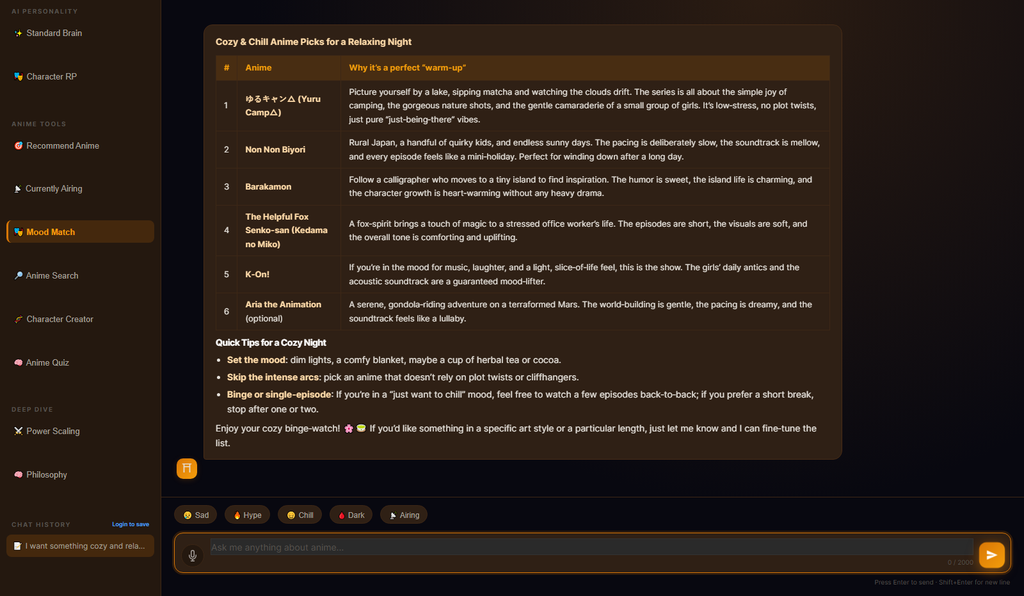
It is a Tuesday, the work call ran long, you have eaten the same thing for dinner three nights running, and the last thing you want is to spend your evening being shouted at by men with swords. You do not have a genre problem. You have a Tuesday problem. The difference matters, because a genre problem gets solved with a genre search and a Tuesday problem does not, and most recommendation advice only knows how to solve one of those.
A genre does not answer a mood question
Ask for a good action anime when you are burned out and you will get a good action anime, which is the last thing you needed. Action is a description of what happens. Mood is a description of what the showing will feel like while it happens, and the two do not reliably track each other. A show can be extremely energetic and relaxing, which is the appeal of a lot of good comedy. A show can be almost entirely still and genuinely harrowing. Nobody watching a quiet afternoon would request a comfort show in those words, yet that is exactly the genre they want.
There is a second problem with the genre route, which is that it makes you do the work at the worst possible time. Turning a feeling into a genre tag requires you to already know the vocabulary of the thing you want, at the exact moment you are least inclined to think. Being tired and slightly sad is not a conducive state for constructing a taxonomy.
The alternative is to describe the emotional shape of the evening instead. Not the genre, not the premise, but the texture of what you want the next two hours to feel like. That is a much easier sentence to produce, and it is a much more useful one, because there is far more agreement about emotional descriptions than about genre labels. Everybody knows what “I want something that will not make me cry tonight” means. Almost nobody agrees what “sad anime” means, because the word covers a quiet grief story, a war crime, a comedy about loss and a romance, all of which are somebody’s sad anime and none of which are the same night.
Say how you feel before you say what you want
The most productive prompt in this whole area is the boring one: tell it what kind of evening you are having. Not what you have watched. Not what you like. How you are doing.
Something like: “Rough week, I am tired and a bit flat, and I do not want anything that will make me feel worse. I would like something I can watch in two or three episodes without losing the thread, something with a competent protagonist and a small cast.” That contains a mood, two hard constraints and a length preference, which is a complete brief in one sentence.
It also does something subtler and more useful. Telling your state out loud to something that is not a person is a cheap way to find out whether you actually know what you want. Often you will discover mid-sentence that you are not tired, you are bored of a specific thing, which is a different problem with a completely different answer. Otaku AI has no opinion about your life, which makes it a decent thing to say that to, because it will not notice you are avoiding the actual question and it will not let you off. It will hand you three titles based on the mood you described rather than the mood you meant, and the mismatch is usually the thing that tells you what you actually meant.
Practically, the assistant remembers what you have said earlier in a session, so you only have to be this honest once. After that, “same as before but a bit less” is a complete instruction, and that is a big deal when your energy for typing sentences is a resource you are already short on.
When you want the adrenaline back
Some evenings you are not tired, you are flat, and the specific thing you want is to feel competent. The right answer is fast, legible violence with clear consequences and a protagonist who wins for reasons you can follow.
Chainsaw Man is a good example of why this is not the same as “big action show.” Twelve episodes, animated by MAPPA, adapted from Tatsuki Fujimoto’s manga, aired in autumn 2022, and built around a protagonist who is outmatched almost continuously. What makes it fit an adrenaline evening is that it never slows down to explain itself, the fights are short and brutal, and there is a different ending song on nearly every episode, which is a strange and rather effective way of keeping a twelve-episode run feeling like twelve distinct events rather than one long one.
Mob Psycho 100 is the other answer, and it is the better one if you want to feel strong rather than brutal. The first season is twelve episodes from Bones, aired in summer 2016, based on ONE’s manga, and it spends its entire run on a boy who is genuinely the strongest person in every room he walks into and is not allowed to enjoy that. The fights escalate enormously while the emotional register stays oddly gentle, which is a rarer and more satisfying combination than pure intensity.
What to avoid when you are in this headspace is anything slow, and this is worth saying explicitly, because the instinct is to assume something gentle is restful. Slow is not restful when you are wound up. Something tight and loud that ends cleanly is what actually unwinds the system.
When you want something heavy and quiet
The other half of the emotional spectrum: you are functional, and you want a show that respects that by having real subject matter and no volume.
Ergo Proxy is twenty-three episodes from Manglobe, broadcast on WOWOW in early 2006, and it is about as committed to its own atmosphere as television gets. Very little of it is fast. The camera holds on rooms longer than you expect. Almost nothing is explained to you for your benefit. If that sounds appealing, this is the register; if you need to be told what is happening, it will read as glacial rather than heavy.
Angel Beats is a strange and often undervalued fit here, thirteen episodes from P.A. Works in 2010, written by Jun Maeda, who also did Clannad and Air, and built on a deliberately cheerful visual style wrapped around a story about grief that is not cheerful at all. Because the surface stays bright, you can watch it when you are not in a state to be handled, and the quiet gut-punches still land.
The practical filter for this mood is worth writing into the prompt: “I want it serious but not cruel, and I do not want a protagonist who keeps getting beaten up for no reason.” That one clause removes an enormous amount of what people get served when they say “dark anime,” and dark is the word that causes most bad evenings in this hobby.
When you want laughter without a joke timeout
Comedy anime has a specific structural problem. It is built on escalating absurdity that needs room to breathe, so many great ones take twenty minutes to reach the joke. If you are tired, that opening stretch is where you close the tab.
Nichijou handles this unusually well, and the reason is that its comedy is at normal human speed rather than at wacky-hiatus speed. Twenty-six episodes from Kyoto Animation, directed by Tatsuya Ishihara and broadcast in spring 2011, built around a high school girl who seems to live inside a delusion, an unexplained deer, a robot and flying salmon. The tone never goes into a separate comedy universe, so nothing has to be explained and nothing has to be caught up on. The joke density is also absurd, which is how it stays funny for twenty-six episodes instead of running out of premises at twelve.
Another approach entirely, if you are really tired: go for a show whose humour is a byproduct rather than its job. Beastars, twelve episodes from the CG studio Orange in autumn 2019, is a drama about a wolf on a school stage crew whose social position is built on suppressing what he is. It is frequently very funny and it is not a comedy at all, so it never has a joke to set up. Comedy that arrives as a side effect tends to be easier to half-watch than comedy that is the meal.
One warning for this mood. Avoid anything where a laugh is the payoff for a long setup, and avoid long gag anime in general, which is a genre and a lifestyle choice and not always the right night.
When you want nothing at all to happen
Sometimes the correct recommendation is something with no threat in it whatsoever. This is a real and specific need, and it is the one most people are worst at requesting, because “relaxing” is treated as a genre and it is not one. It is a property.
Yuru Camp is the reliable answer. Twelve episodes from C-Station in winter 2018, following two women who take trips alone and eat very good food, with Mount Fuji in most of the shots and no conflict of any consequence. Nothing is at stake. Nobody is in danger. The tension is entirely about whether the tent goes up in the rain.
Violet Evergarden is thirteen episodes from Kyoto Animation, from January to April 2018, and it is not a low-stakes show, so if the requirement is genuinely nothing happening, this is the wrong recommendation. But it is quiet, the structure is one letter at a time, and there is something about watching someone relearn how to talk to people that works as a settling thing. Sometimes what people mean by relaxing is not the absence of stakes but the absence of noise, and those are different requests worth making separately.
For this mood, put the constraint in the prompt explicitly: “nothing where anybody is in danger, nothing with a countdown, nothing that expects me to remember names.” That last clause matters more than people expect, since a cast of thirty fictional names at the end of a long day is a genuine barrier.
What mood mode explains that a list cannot
Otaku AI has a mode built for exactly this, called Mood Match, and the thing that separates it from a filtered list is that it does not just hand you titles. It recommends a small number of them, three to five, and for each one it explains the emotional resonance, meaning why that particular show lands for the state you described.
That explanation is the feature. “Here are five anime” is a list you now have to evaluate alone. “Here are five anime, and here is how each one is going to feel, and here is the specific thing in it that is doing the work you asked for” is a recommendation you can act on without another twenty minutes of research. When you are tired, the twenty minutes is exactly the part that does not happen, so the difference is not cosmetic.
It is also a better fit than a genre filter because mood descriptions map onto real properties of a show. Something is comforting or it is not. Something is relentless or it is not. Something will make you feel stupid for watching it or it will not. Those are things you can actually be told about a show and can act on, in a way that “it is a good story” is not.
Two details about how it works are worth knowing, because they change how much you should expect from one answer. The full conversation is sent along with each request, and the session stores the facts you have given it, so a mood you described at the start of a long chat is still available at the end of it. And nothing about that requires an account. You can start, say how your evening is going, get three or four titles, and close the tab, and the tool has still done the only thing that matters, which is convert a feeling into something watchable.
The prompt that gets you three good titles
Here is a full example, written the way it would actually be typed on a bad evening.
“Long day, kind of wired rather than tired, and I want to watch something that keeps me locked in without making me angry. Preferably under 13 episodes so I can finish it this week. Something with good action, and I do not want anything set in a school.”
Three things in there are doing real work. “Wired rather than tired” distinguishes this from the flat mood that would call for something else entirely, and it stops the answer sliding toward gentle slice-of-life. “Under 13 episodes” is a hard boundary that will be respected. “Nothing set in a school” is the exclusion that does most of the deleting, because a large share of short anime are school-based.
The pattern generalises. State the mood, not the genre. Give one hard limit on length. Give one exclusion. That is four pieces of information and takes about twenty seconds to type. It converts a coin flip into a shortlist, and the shortlist can be argued with.
Why mood-based picks age better than genre picks
A genre answer goes stale in about eighteen months, because the shelf of new things in any given genre changes fast and the best of a genre is increasingly determined by what came out recently rather than what is good.
A mood answer barely changes at all. The set of anime that reliably produce a specific feeling is extremely stable. There are not a great many shows that will reliably make you feel warm and unhurried, and there never will be, because that depends on pacing and restraint rather than on budget or season. The title attached to the description is almost incidental. If a recommendation gives you “Violet Evergarden, because the quietness of it will settle you,” that reasoning is still true in five years and probably true about something else too.
This is also why mood lists are better at avoiding the “I have already seen everything” problem. You are not browsing a genre, you are picking a feeling, and the feeling has a much longer tail of unconsidered options than any genre does.
Two cautions. A mood answer will sometimes hand you a show you already finished years ago, which is a sign you need to add “I have already seen” exclusions. And be suspicious of a recommendation whose emotional pitch is vague, because “beautiful and heartfelt” is a mood-shaped sentence carrying no information.
A mixing strategy for a long week
One request per bad evening does not scale. Over a rough stretch you will burn through anything good, and the honest answer to that is that you need more than one source and more than one kind of ask.
The workable pattern is a rotation across three axes. Vary the emotional target, so you do not get three variations on the same mood. Vary the length, so short things sit next to something you commit to. And occasionally move off mood entirely, because sometimes what a bad week needs is not a show that matches the feeling but one that has no business being in the same conversation. Picking the next series properly is worth doing on a neutral day so that mood-requests are not the only kind you know how to make.
Two more practical notes. If you are following something week by week, that is a different resource and a different failure mode, and tracking what is currently airing without losing your place covers the logistics of it. And if a mood suggestion sounds right but you are unsure you want the commitment, finding anime similar to a show you already love is the follow-up that narrows a recommendation down to a decision.
Once you get used to asking by state of mind rather than by genre, keep the habit. If the answers are consistently unimpressive, your description is probably pitched at a level of abstraction where nothing interesting lives, so drop a level and describe a specific scene instead, as in finding anime from a single remembered moment. And if the real barrier is that you like something but are not sure it deserves twelve episodes of your Tuesday, deciding whether an anime is worth starting will stop you wasting the mood on a show that was never going to fit tonight. Underrated anime you have probably not seen is the other half of the answer, since the well-known picks get exhausted long before the good stuff runs out.